
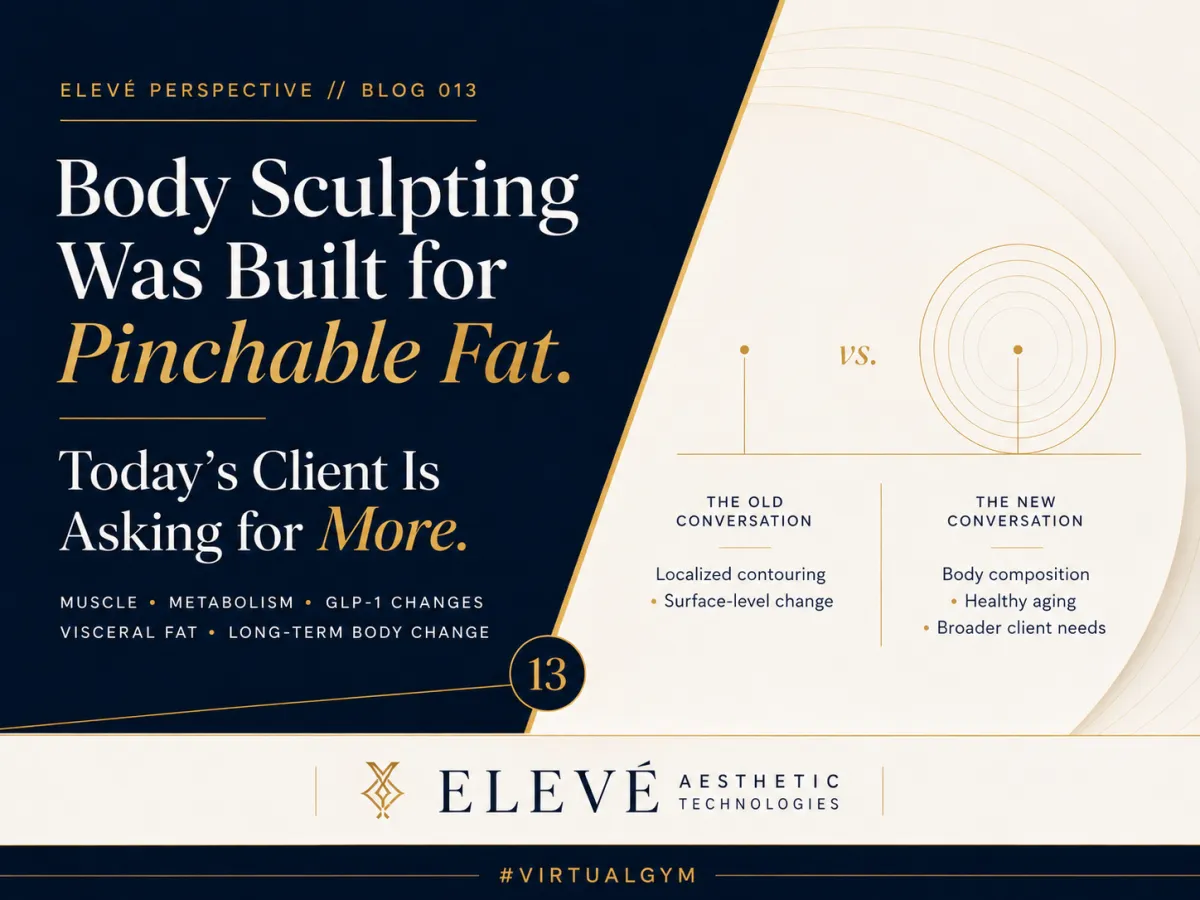
Body Sculpting Was Built for Pinchable Fat. Today’s Client Is Asking for More.
Body Sculpting Was Built for Pinchable Fat. Today’s Client Is Asking for More.
The body-sculpting category was built around localized contouring. But today’s client conversation now includes muscle, metabolism, GLP-1 changes, visceral fat, and long-term body change.
Published by Jill Robertson | Founder, Elevé Aesthetic Technologies
Category: ELEVÉ PERSPECTIVE
Quick Answer
Traditional body sculpting was largely built around localized, pinchable fat — the kind of fat a client can point to, grab, or ask to contour.
That client still exists.
But today’s body client is asking broader questions about muscle, metabolism, GLP-1 weight loss, menopause-related waist changes, visceral fat, healthy aging, and long-term body change.
For clinics, that means the body-technology conversation has to move beyond surface-level contouring alone.
For years, the body-sculpting category has been built around a fairly narrow question:
Can we reduce this area I can pinch?
That question still matters.
Many clients still walk into a clinic with a localized area they want to change. Lower abdomen. Flanks. Thighs. Arms. The classic body-sculpting client is often close to goal weight and looking for contouring in a specific area.
In other words, much of the category was built around pinchable fat.
But that is no longer the whole conversation.
Today’s client is asking for more.
She may still care about inches. She may still want her waist to change. She may still want her clothes to fit differently.
But she may also be thinking about:
GLP-1 weight loss.
Muscle loss.
Menopause-related waist changes.
Metabolic resistance.
Visceral fat.
Healthy aging.
Long-term body change.
What happens after the scale moves.
That is a very different client conversation.
And it requires clinics to think differently about the technology they bring into their practice.
The old body-sculpting question was too small
Traditional body-sculpting conversations usually start with what can be seen from the outside.
A visible bulge.
A stubborn pocket.
A before-and-after photo.
A localized treatment area.
A surface-level change.
There is nothing wrong with that conversation.
For the right client, localized contouring can be meaningful. A client who is already near her goal and wants to treat a specific area may still be a fit for that kind of approach.
But the market has changed.
The client walking into a clinic today may not only be asking:
Can you reduce this area?
She may be asking:
What is happening to my muscle?
Why does my waist look different after 40?
What am I losing while I lose weight?
Why does my body feel softer even though the scale is down?
How do I support metabolism while my body is changing?
What about deeper fat that does not show up in a pinch?
Those are bigger questions than the old category was designed to answer.
Even the mainstream conversation started with pinchable fat
This is not just an industry assumption.
For years, mainstream conversations around body sculpting often framed the category around a specific kind of client: someone close to their goal weight with a localized area of fat they could pinch, point to, and want reduced.
That framing made sense for the technologies being discussed at the time.
It also reveals the limitation.
When a category is built around a “pinchable fat” client, the conversation naturally stays focused on surface-level contouring.
But today’s client is often asking about more than what can be pinched.
She may be asking about muscle, metabolism, GLP-1-related body changes, menopause-related waist changes, visceral fat, and long-term body maintenance.
That is why the body-technology conversation has to evolve.
GLP-1s changed the conversation
GLP-1 medications have changed the way many clients think about weight loss.
For some, the scale is finally moving after years of frustration. But as weight comes down, a new set of concerns can appear.
Clients may notice changes in shape.
They may worry about muscle.
They may feel smaller but not stronger.
They may see the number on the scale improve while still feeling uncertain about body composition, metabolism, and long-term maintenance.
For clinics, this creates a major shift.
The opportunity is no longer just to offer another fat-reduction service.
The opportunity is to help clients understand what kind of body change they are actually pursuing.
A smaller body is not always the same as a stronger, more supported, more metabolically resilient body.
That is why the technology conversation matters.
The 40+ client is also changing the category
GLP-1s are not the only reason the conversation is changing.
Many clients over 40 are dealing with body changes that do not fit neatly into the old “pinch this area” model.
Waist changes.
Hormonal shifts.
Muscle loss.
Changes in energy.
Changes in recovery.
More resistance to the same habits that used to work.
This client may not be looking for a beauty treatment.
She may be looking for something that feels more aligned with where her body is now.
She wants to understand why her body is changing, what can be measured, and what kind of support makes sense beyond diet and exercise alone.
That is where the old body-sculpting language often starts to feel limited.
Because “treat the bulge” is not the same as supporting a bigger body-technology conversation.
Pinchable fat is not the whole story
The fat someone can pinch is usually subcutaneous fat.
It sits closer to the surface.
That is the fat most traditional body-sculpting technologies were built to address.
But today’s client may also be thinking about visceral fat — the deeper fat stored around internal organs.
This is not the same as a surface-level contouring concern, and it does not fit neatly into the same visual before-and-after conversation.
For clinic owners, this distinction matters.
A device may create a visible change in a localized area.
But that does not automatically mean it supports the broader issues today’s clients are asking about.
This is where buyer education becomes important.
When evaluating body technology, clinics should not only ask:
What area can this treat?
They should also ask:
What conversation does this technology allow us to lead?
What does it help us measure?
What client problem does it actually fit?
Is it built for surface-level contouring only, or does it support a broader body-composition conversation?
Those questions are becoming more important.
The category is expanding
The body-sculpting category is not going away.
But it is expanding.
The old conversation was mostly about fat reduction and contouring.
The new conversation includes:
Muscle.
Metabolism.
Visceral fat.
Healthy aging.
GLP-1 support.
Waist changes.
Client education.
Long-term body maintenance.
Measurable progress beyond the mirror.
That does not mean every clinic needs to abandon what already works.
But it does mean clinics should be careful about adding another device that only answers the same narrow question.
Because if the client conversation has expanded, the technology strategy should expand too.
Where Virtual Gym Max fits
The Virtual Gym Max was not designed as another heat, freeze, or forced-contraction device.
It belongs in a different body-technology conversation.
Virtual Gym Max is signal-based and non-thermal. It is designed to support measurable inch loss, muscle building over a series, metabolism support, and visceral-fat reduction.
That matters because it gives clinics a different way to talk about body change.
Not just:
Can we reduce this pinchable area?
But:
How can we support the body in a more complete way?
That shift matters for med spas, wellness clinics, chiropractic offices, functional-health practices, and other providers serving clients who are no longer satisfied with a surface-level explanation.
The technology a clinic chooses determines the conversation it gets to lead.
Clinics do not need another lookalike body service
Many practices already have access to body-sculpting devices.
Some use heat.
Some use freezing.
Some use forced contractions.
Some rely on temporary visible reactions.
Some are difficult to explain beyond the promise of fat reduction.
The problem is not that every older technology is bad.
The problem is that many clinics are being asked to invest in another version of a conversation their market has already heard.
Another contouring device.
Another before-and-after promise.
Another “stubborn fat” treatment.
Another surface-level pitch.
But today’s client may be asking a different question.
That is the gap.
And that is the opportunity.
The better buyer question
Before investing in another body device, clinic owners should ask:
Was this technology built for the old body-sculpting conversation — or the client conversation happening now?
That question changes how you evaluate the purchase.
It moves the decision beyond price, brand recognition, or what competitors already offer.
It forces a more strategic conversation:
Does this technology fit today’s client?
Can my team explain the mechanism clearly?
Does it support measurable progress?
Does it help us talk about muscle, metabolism, and visceral fat?
Does it strengthen our practice identity?
Does it create differentiation, or does it make us look like everyone else?
Those are the questions that matter now.
Frequently Asked Questions
What does “pinchable fat” mean?
“Pinchable fat” usually refers to subcutaneous fat — the fat stored closer to the surface, just under the skin.
This is the type of fat many traditional body-sculpting technologies were designed to address through localized contouring.
Is pinchable fat still a valid body-sculpting concern?
Yes. Many clients still want help with localized areas like the abdomen, flanks, thighs, or arms.
The point is not that this concern no longer matters.
The point is that it is no longer the whole conversation.
Today’s clients may also be asking about muscle, metabolism, visceral fat, GLP-1 weight loss, menopause-related waist changes, and long-term body maintenance.
Why does visceral fat matter in the body-technology conversation?
Visceral fat is deeper fat stored around internal organs.
It is not the same as surface-level fat, and it does not fit neatly into the traditional “pinch this area” body-sculpting model.
For clinics, visceral fat matters because it expands the conversation beyond cosmetic contouring and into broader body change, wellness, and metabolic support.
How did GLP-1 weight loss change the body-sculpting conversation?
GLP-1 medications have helped many people lose weight, but weight loss can raise new questions about muscle, shape, metabolism, and long-term maintenance.
Clients may be smaller, but still concerned about softness, strength, body composition, or what kind of weight they are actually losing.
That creates an opportunity for clinics to offer a more relevant body-technology conversation.
How is Virtual Gym Max different from traditional body-sculpting devices?
Virtual Gym Max is not based on heat, freezing, or forced contractions.
It is signal-based, non-thermal technology designed to support measurable inch loss, muscle building over a series, metabolism support, and visceral-fat reduction.
That gives clinics a different way to talk about body change — beyond surface-level contouring alone.
Is Virtual Gym Max only for med spas?
No. Virtual Gym Max can fit a variety of practices, including med spas, wellness clinics, chiropractic offices, functional-health practices, and other providers serving clients who care about muscle, metabolism, visceral fat, and long-term body change.
The bigger question is not simply whether a clinic offers aesthetics.
The better question is whether the technology fits the practice’s client conversation and long-term positioning.
What should clinic owners ask before buying body-sculpting equipment?
Clinic owners should ask whether the technology only addresses localized surface fat, or whether it supports a broader body-technology conversation.
They should also ask:
Can we clearly explain the mechanism?
Does it fit today’s client concerns around muscle, metabolism, GLP-1 changes, visceral fat, and healthy aging?
Does it differentiate our practice, or make us look like everyone else?
Those questions matter more than simply asking what device is popular right now.
The bottom line
Body sculpting was built for pinchable fat.
That client still exists.
But today’s client is asking for more.
She is asking about muscle, metabolism, GLP-1 changes, menopause, visceral fat, waist changes, healthy aging, and what kind of body change actually lasts.
For clinics, the opportunity is not just to add another body-sculpting service.
The opportunity is to lead a more relevant body-technology conversation.
And that starts with choosing technology built for more than the surface.
Ready to compare body technology more clearly?
Before you invest in another body-sculpting device, compare the category, mechanism, client fit, workflow, and proof.
Download the 2026 Body-Sculpting Decision Kit or schedule a 20-minute review call with Elevé Aesthetic Technologies to compare categories, mechanisms, and buyer-fit before making your next equipment decision.
Virtual Gym Max is available in the U.S. through Elevé Aesthetic Technologies. Outcomes vary by client, protocol, and practice implementation.


