
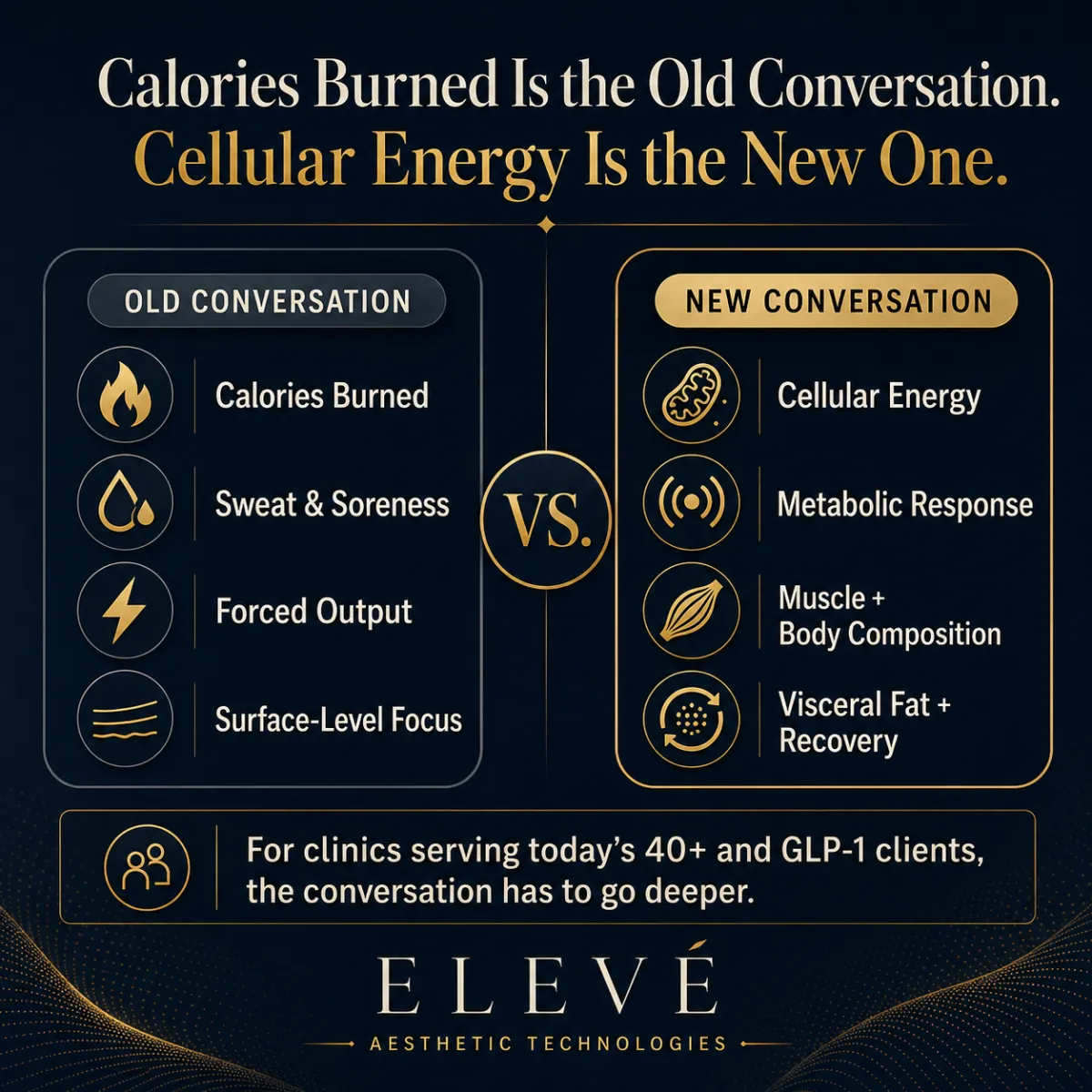
Calories Burned Is the Old Conversation. Cellular Energy Is the New One
Calories Burned Is the Old Conversation. Cellular Energy Is the New One.
Why body-sculpting technology has to move beyond sweat, soreness, and calorie math
Published by Jill Robertson | Elevé Aesthetic Technologies
Quick Answer
For years, the fitness and body-sculpting industries have been built around the same familiar ideas:
Burn more calories.
Sweat more.
Work harder.
Force more contractions.
Create a stronger sensation.
But the body is not just a calorie-burning machine.
It is an energy-producing, signal-responding, biologically adaptive system.
That distinction matters.
Especially for clients who are over 40, post-menopausal, on GLP-1 medications, metabolically resistant, inflamed, stressed, deconditioned, or frustrated because their body no longer responds the way it used to.
For these clients, the old conversation is incomplete.
The better question is not simply:
How many calories did this burn?
The better question is:
Did this help the body produce, use, and respond to energy more effectively?
That is the next body-composition conversation.
And clinic owners need to understand it before investing in another piece of equipment designed for the old model.
The Old Conversation: Calories Burned
The old fitness conversation was simple:
Eat less.
Move more.
Burn calories.
Create a deficit.
That model is not completely wrong.
Calories matter.
But calories are not the whole story.
If calories were the only story, every client who tracked food, exercised, walked, lifted weights, and followed the rules would get the results they expected.
But that is not what many clinics are seeing.
Clients are walking in saying:
“I am doing everything right, but nothing is changing.”
“I used to lose weight easily, and now my body does not respond.”
“I work out, but my waist is not changing.”
“I lost weight, but I feel weaker.”
“My metabolism feels broken.”
“I am exhausted, inflamed, and stuck.”
That is not always a motivation problem.
It is not always a discipline problem.
And it is not always a simple calorie problem.
Sometimes the body is struggling with the deeper systems that determine whether it can respond well in the first place.
That is where the conversation has to evolve.
Calories Are a Measurement. Energy Is a System.
A calorie is a unit of measurement.
It tells you how much energy is contained in food or expended through activity.
But the body does not experience energy as a math equation on an app.
The body experiences energy through biology.
Cellular energy affects:
Muscle function
Recovery
Metabolism
Hormonal signaling
Fat metabolism
Stress response
Inflammation
Tissue repair
Exercise tolerance
Body composition quality
So when a clinic focuses only on calories burned, it may be missing the deeper issue.
The client does not just need to “burn more.”
She may need her body to use energy better.
She may need better metabolic responsiveness.
She may need better recovery.
She may need better cellular communication.
She may need support for muscle, visceral fat, inflammation, and the nervous system.
That is a much bigger conversation than calorie burn.
Why “Burning Calories” Is Not Enough for the 40+ Client
The 40+ client is often not dealing with the same body she had at 25.
Hormones shift.
Muscle becomes harder to maintain.
Recovery slows.
Stress load increases.
Sleep changes.
Inflammation may rise.
Visceral fat becomes more relevant.
The nervous system may stay stuck in survival mode.
So when this client is told to simply burn more calories, the advice can feel frustrating.
Not because movement does not matter.
It does.
But because her body may not be responding to effort the way it used to.
This is one of the biggest missed opportunities in body technology.
A 45-, 55-, or 65-year-old client may not need a harder treatment.
She may need a smarter one.
She may need technology that supports a broader response, not just a local event.
That means the conversation has to move beyond:
How many contractions?
How much heat?
How much sweat?
How many calories?
How intense did it feel?
And toward:
What changed in body composition?
What happened to muscle?
What happened to visceral fat?
What happened to metabolic markers?
Did the client feel better?Did the body respond more effectively over time?
That is the shift.
Output Is Not the Same as Adaptation
Many technologies focus on output.
More intensity.
More contractions.
More heat.
More sensation.
More visible movement.
Output can look impressive.
But output is not the same as adaptation.
A device can make a muscle contract without creating a meaningful systemic response.
A treatment can feel intense without improving body composition.
A session can burn calories without changing how the body functions.
A client can sweat and still remain metabolically stuck.
That is why “calories burned” can be a shallow metric.
It tells you something happened.
It does not tell you whether the body adapted in a useful way.
For clinic owners, that distinction matters because the goal is not to impress a client for one session.
The goal is to create a service that leads to:
Measurable change
Repeat visits
Trust
Retention
Package conversion
Better client conversationsA stronger business model
Those things come from outcomes, not intensity alone.
The Better Conversation: Cellular Energy
The body runs on cellular energy.
Every process in the body requires energy to happen.
Muscle contraction requires energy.
Fat metabolism requires energy.
Repair requires energy.
Hormonal signaling requires energy.
Immune function requires energy.
Detoxification requires energy.
Recovery requires energy.
When the body has poor energy production or poor energy efficiency, the client may feel it everywhere.
Low energy.
Slow recovery.
Brain fog.
Poor exercise tolerance.
Weight-loss resistance.
Muscle loss.
Inflammation.
A body that feels like it is working against her.
This is why the future of body technology cannot just be about burning calories.
It has to be about supporting the body’s ability to produce, organize, and use energy more effectively.
That is a very different category of conversation.
And it is especially relevant for clinics that serve wellness, longevity, hormone, metabolic, body-composition, or 40+ clients.
Why ATP Belongs in the Body-Composition Conversation
ATP is the body’s usable energy currency.
It is what cells use to perform work.
If the body is trying to build muscle, repair tissue, regulate metabolism, mobilize fat, recover from stress, or maintain healthy function, cellular energy matters.
That does not mean every clinic needs to turn into a biochemistry lecture.
But clinic owners do need to understand this:
A body-composition service that only focuses on external appearance may miss the deeper systems that influence whether the body can actually change.
The client does not just need a smaller measurement.
She needs a body that can respond.
That means energy production, recovery, signaling, and metabolic efficiency all belong in the conversation.
This is where technology selection becomes important.
Because if a device is only designed to create a local effect, it may not support the broader metabolic conversation your client actually needs.
The Problem with “Calories Burned” as a Sales Hook
“Calories burned” is easy to market.
It is simple.
It is familiar.
It makes people feel like something was accomplished.
But it can also trap clinics in an outdated conversation.
Here is the problem:
A client can burn calories and still lose muscle.
A client can burn calories and still have visceral fat.
A client can burn calories and still have poor recovery.
A client can burn calories and still feel depleted.
A client can burn calories and still not improve body composition.
That is why calorie burn should not be the highest-value promise.
For many clients, especially those in the GLP-1 era, the question is no longer:
How do I make the scale go down?
The better question is:
How do I improve what my body is made of?
Body composition requires more than calorie burn.
It requires a conversation around muscle, metabolism, visceral fat, energy, and long-term responsiveness.
How This Connects to GLP-1 Clients
GLP-1 medications have made this conversation more urgent.
Many clients are already losing weight.
The scale may already be moving.
But now they are asking:
Am I losing fat or muscle?
How do I keep my shape?
How do I avoid feeling soft or depleted?
How do I support metabolism?
How do I maintain results long term?
How do I address visceral fat?
That is not a calorie-burning question.
That is a body-composition question.
And it is also an energy question.
Because muscle, metabolism, recovery, and fat utilization all depend on how well the body produces and uses energy.
Clinics that keep talking only about weight loss may miss the moment.
Clinics that understand body composition and cellular energy will be able to lead a more relevant conversation.
Why Visceral Fat Changes the Standard
Visceral fat is not the same as the fat someone can pinch.
It is deeper.
It is stored around organs.
And it is connected to broader metabolic function.
That means a purely surface-level strategy may not be enough.
Many older body-sculpting technologies were built around subcutaneous fat, localized contouring, or visible changes in the treatment area.
That can be useful for certain clients.
But if the client’s bigger issue involves visceral fat, metabolic resistance, inflammation, hormones, or poor responsiveness, the standard has to change.
The question becomes:
Does this technology have a mechanism that supports deeper metabolic change?
Not just:
Can it heat tissue?
Can it freeze fat?
Can it force a contraction?
Can it create sensation?
Those are local effects.
The visceral-fat conversation requires a broader body-level response.
That is where calorie burn alone becomes too small of a metric.
Where Traditional Fitness and Body Tech Fall Short
Traditional fitness is valuable.
Strength training matters.
Walking matters.
Nutrition matters.
Protein matters.
Medical guidance matters.
None of that goes away.
But for many clients, the problem is not that they have never tried.
The problem is that they have tried for years and still feel stuck.
The same is true with older body-sculpting technology.
A client may have tried fat freezing, RF, laser, stimulation, or other treatments and still feel like the results did not match the promise.
That does not always mean those technologies did nothing.
It means they may not have matched the client’s deeper problem.
If the client needs muscle, metabolism, visceral-fat support, better signaling, recovery, and a more responsive body, a local-only approach may not be enough.
That is why clinics need to stop asking only:
What does this device do to the treatment area?
And start asking:
What response does this technology help the body create?
The New Standard: Metabolic Responsiveness
The next category of body technology will not be defined only by fat reduction.
It will be defined by metabolic responsiveness.
That means helping clients move toward a body that:
Builds or preserves muscle
Uses energy more efficiently
Supports fat metabolism
Improves body composition
Responds better over time
Feels stronger and more supported
Can maintain progress more effectively
This is not just an aesthetic conversation.
It is the bridge between aesthetics, wellness, longevity, metabolic health, and functional body composition.
That is where the market is moving.
And that is where clinics can differentiate.
Because every clinic can say “lose inches.”
Not every clinic can lead a serious conversation about body composition, energy, metabolism, and response.
Why This Matters for Clinic Owners
The technology you buy determines the conversation you can lead.
If your device is built around calories burned, you will likely sell calorie burn.
If your device is built around forced contractions, you will likely sell contractions.
If your device is built around heat, you will likely sell tissue effects.
If your device is built around surface-level contouring, you will likely sell surface-level change.
But if your clients are asking deeper questions, your technology has to support a deeper conversation.
That matters for:
Positioning
Pricing
Packages
Client education
Rebooking
Retention
Referral value
Brand differentiation
Long-term service relevance
The highest-value clinics will not be the ones with the loudest treatment.
They will be the ones with the clearest mechanism and the most relevant outcomes.
What Clinic Owners Should Ask Before Buying
Before investing in body-sculpting or metabolic wellness technology, ask:
Is this device built around calorie burn, local effect, or biological response?
Does it support muscle building or just create temporary contraction?
Does it have a mechanism beyond the treatment area?
Does it support body composition, not just inch loss?
Does it address visceral fat, or only subcutaneous fat?
Does it fit the needs of 40+ clients?
Does it support clients who are losing weight on GLP-1 medications?
Can results be measured beyond a before-and-after photo?
Can the service be packaged into a program?
Is the experience comfortable and rebook-friendly?
Can my team explain the mechanism clearly?
Does this technology belong in the next conversation, or the old one?
Those questions will tell you more than a demo ever will.
A Better Way to Talk About Results
Instead of saying:
“This burns calories.”
Say:
“This supports body composition.”
Instead of saying:
“This works like a workout.”
Say:
“This supports muscle, metabolism, and measurable change.”
Instead of saying:
“This tones the body.”
Say:
“This helps build the structure clients need as their body changes.”
Instead of saying:
“This treatment is intense.”
Say:
“This technology is designed to help the body respond.”
That language is not just more accurate.
It is more valuable.
Because clients are tired of being told to work harder.
Many of them want to understand why their body stopped responding.
And clinic owners who can explain that clearly will stand out.
The Bottom Line
Calories burned is the old conversation.
Cellular energy is the new one.
The next era of body technology will not be led by devices that only create sensation, sweat, or local tissue effects.
It will be led by technologies that help clinics speak to the deeper body-composition conversation:
Muscle.
Metabolism.
Visceral fat.
Recovery.
Energy.
Communication.
Response.
Because the client walking into clinics now is not just asking to be smaller.
She wants a body that feels stronger, functions better, and responds again.
That requires more than calorie math.
It requires a better mechanism.
And for clinic owners, that is where smarter technology decisions begin.
Frequently Asked Questions
Why is calorie burn not enough when evaluating body-sculpting technology?
Calorie burn only tells you that energy was expended. It does not tell you whether the technology improved body composition, supported muscle, addressed visceral fat, improved metabolic responsiveness, or created a meaningful biological response.
What is cellular energy?
Cellular energy refers to the usable energy cells need to perform work, including muscle function, repair, metabolism, recovery, and signaling. ATP is often described as the body’s usable energy currency.
Why does cellular energy matter for body composition?
Body composition depends on more than fat loss. Muscle building, fat metabolism, recovery, and metabolic function all require energy. If the body is not producing or using energy well, visible change may be harder to achieve.
How does this apply to GLP-1 clients?
Many GLP-1 clients are already losing weight. The bigger question becomes what they are losing and what they are maintaining or building. Muscle, metabolism, visceral fat, and body composition become more important than weight loss alone.
Are traditional workouts still important?
Yes. Strength training, walking, nutrition, protein intake, and provider-guided medical care still matter. The point is not to replace healthy habits. The point is to recognize that many clients need additional support for body composition and metabolic responsiveness.
What should clinic owners look for in new technology?
Clinic owners should look for technology with a clear mechanism, measurable outcomes, client comfort, repeatable sessions, body-composition relevance, and a service model that supports programs rather than one-off treatments.
CTA
Before you invest in another body-sculpting device, make sure it is built for the conversation your clients are actually having now.
Download the 2026 Body Sculpting Decision Kit to compare mechanisms, outcomes, clinical evidence, and total business fit before you buy.
Or book a Review Call to talk through whether the Virtual Gym is the right fit for your clinic, wellness center, gym, or med spa.


