
The Nervous System and Body Sculpting Technology
The Nervous System Belongs in the Body-Sculpting Conversation
Why next-generation body technology has to move beyond tissue and start talking about communication
Published by Jill Robertson | Elevé Aesthetic Technologies
Quick Answer
Most body-sculpting technology is still evaluated by what it does to tissue.
Does it heat the tissue?
Freeze the fat?
Force a contraction?
Create sensation?
Change the treatment area?
Those are useful questions, but they are not enough anymore.
Today’s client is often dealing with more than a surface-level concern. She may be navigating hormonal shifts, metabolic resistance, visceral fat, GLP-1-related body changes, inflammation, stress physiology, muscle loss concerns, or the frustrating feeling that her body no longer responds the way it used to.
That is why the nervous system belongs in the body-sculpting conversation.
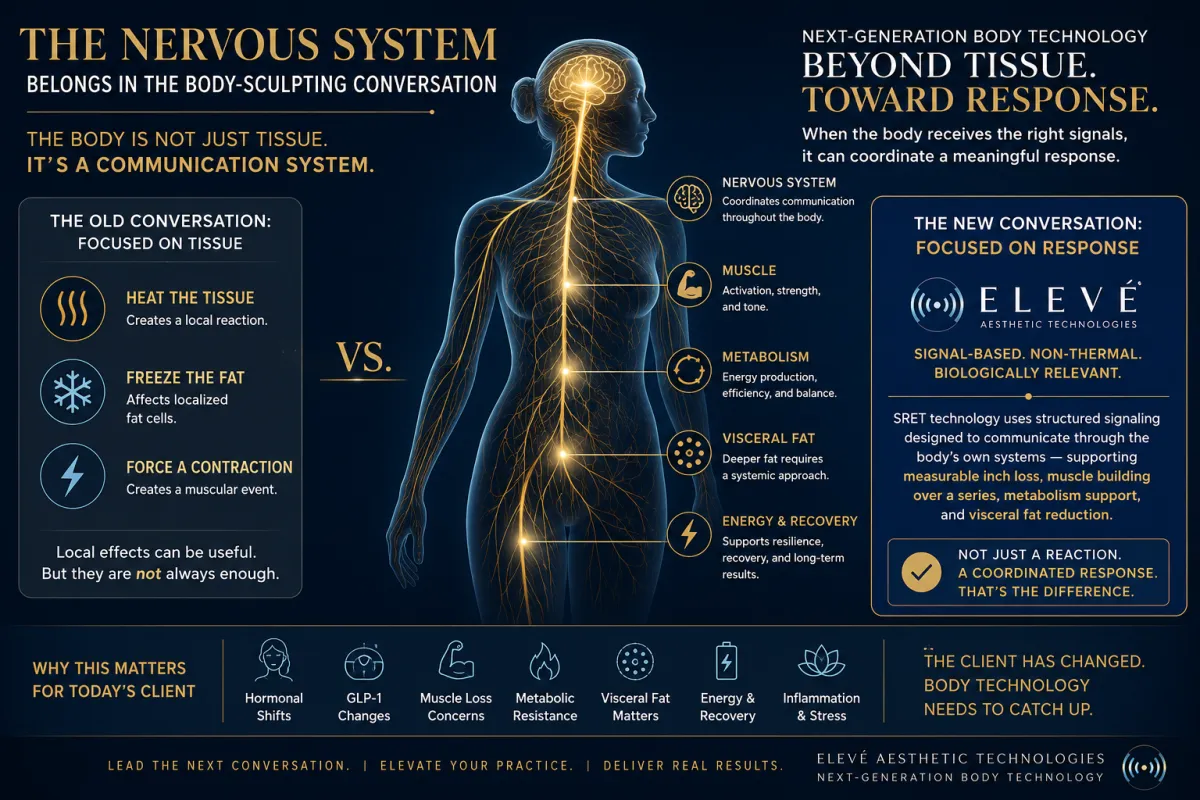
The nervous system is not a side note. It is the body’s communication network. It helps coordinate muscle, metabolism, hormones, stress response, recovery, energy use, and fat metabolism.
So the better question for clinic owners is not only:
What does this device do to tissue?
The better question is:
What kind of response does this technology help the body organize?
That distinction changes everything about how clinics evaluate body technology.
The Old Body-Sculpting Conversation Was Mostly About Tissue
For years, body-sculpting technology has been explained through a tissue-first lens.
Freeze the fat.
Heat the tissue.
Force the muscle.
Disrupt the cells.
Target the area.
Treat the pocket.
That model made sense for the client body sculpting was originally built around.
Someone close to goal weight.
Someone with a small area of pinchable fat.
Someone looking for localized contouring.
Someone who wanted a visible change in one treatment area.
That client still exists.
But she is no longer the whole market.
The client walking into clinics now may be 45, 55, or 65. She may be post-menopausal. She may be using or considering GLP-1 medication. She may be losing weight but worried about muscle. She may be doing the “right things” but not seeing the body response she expected. She may have visceral fat concerns that do not behave like surface-level fat.
That is a different client.
And a different client requires a different technology conversation.
The Client Has Changed
The body-sculpting client of today is not always asking, “Can you treat this one spot?”
She may be asking:
“Why does my waist not change anymore?”
“Why did I lose weight but feel softer?”
“Why am I worried about muscle loss?”
“Why did menopause change my shape so much?”
“Why am I working harder and getting less response?”
“What is happening underneath the weight loss?”
“How do I keep my metabolism, muscle, and shape as my body changes?”
Those are not just surface-level questions.
They are response questions.
They involve metabolism, hormones, muscle, visceral fat, cellular energy, inflammation, recovery, and stress physiology.
And all of those systems are connected through communication.
That is where the nervous system becomes important.
The Nervous System Is the Body’s Communication Network
The nervous system helps coordinate what happens throughout the body.
It is involved in movement, sensation, stress response, recovery, metabolism, muscle engagement, hormone signaling, and energy regulation.
In simple terms, the nervous system helps the body decide:
What to activate.
What to conserve.
What to repair.
What to store.
What to release.
What to prioritize.
That matters in body transformation because the body does not change through tissue alone.
Muscle does not build without communication.
Fat metabolism does not happen without signaling.
Recovery does not happen without regulation.
Hormones do not act in isolation.
Metabolism is not just math.
Energy production is not just calories.
The body is an integrated system.
So when a client says, “My body stopped responding,” the question is not always whether she needs more force, more intensity, or another surface-level treatment.
The question may be whether the body is receiving and organizing the right signals.
Metabolism Is Not Just a Calorie Conversation
Many clinics are still stuck in the old equation:
Burn more calories.
Create more contractions.
Push more intensity.
Create more sensation.
Make the treatment feel powerful.
But the modern client often needs a more sophisticated explanation.
Metabolism is influenced by signals.
Stress signals.
Hormonal signals.
Inflammatory signals.
Nervous-system signals.
Muscle signals.
Energy signals.
Recovery signals.
When those signals are clear and coordinated, the body may respond more efficiently.
When those signals become noisy, poorly timed, or dysregulated, the body may become harder to influence.
This is why so many clients feel frustrated.
They are not always doing nothing.
They are often doing a lot.
But their body is not responding in the same way.
That is a different problem than simply needing another treatment that attacks tissue.
Why Local Effects Are Not Always Enough
A local effect can be useful.
Heating tissue can create a local response.
Freezing fat can affect localized fat cells.
Forced contractions can create a muscular event.
Mechanical or electrical stimulation can create sensation or movement.
Those are real effects.
But they are still local effects.
And local effects should be evaluated as local effects.
The issue is not whether those technologies are bad. The issue is whether they match the client’s actual problem.
If the client’s concern is a small pocket of surface-level fat, a localized approach may make sense.
But if the client is dealing with muscle loss concerns, metabolic resistance, visceral fat, hormonal shifts, GLP-1-related changes, inflammation, or a body that no longer responds the way it used to, then the conversation needs to expand.
A local effect may not be enough if the client’s problem is systemic.
That is why clinic owners need to understand whether a device is creating a local reaction or helping support a coordinated biological response.
The Nervous System Connects the Surface to the System
This is the missing bridge in many body-sculpting conversations.
The surface is what clients see.
The system is what determines how the body responds.
The nervous system is one of the major communication pathways between the two.
That matters because body transformation is not just about what happens at the treatment area. It is also about whether the body recognizes the input and organizes a meaningful response.
A treatment can create sensation without creating a useful signal.
A device can force movement without creating systemic coordination.
A session can feel intense without improving the body’s responsiveness.
A local reaction can look impressive without becoming a repeatable program.
The nervous system gives clinic owners a better way to think about technology.
Not just:
What did the client feel?
But:
What did the body understand?
Why This Matters More for 40+ Clients
The 40+ client often does not respond like the 25-year-old client.
That does not mean she is broken.
It means her internal environment may be different.
Hormones shift.
Stress load accumulates.
Sleep may change.
Inflammation may increase.
Muscle becomes harder to maintain.
Visceral fat becomes more relevant.
Recovery may slow down.
Metabolic flexibility may decrease.
So when this client walks into a clinic, she may not be looking for a quick surface fix.
She may be looking for an explanation.
Why did the old workouts stop working?
Why did the scale change but her shape did not?
Why does her waist feel different after menopause?
Why is she losing weight but worried about strength and muscle?
Why does her body feel less responsive?
Those questions cannot be fully answered with “we heat fat” or “we make the muscle contract.”
That client needs a more relevant body-technology conversation.
And clinics that can lead that conversation will stand out.
GLP-1s Made This Conversation Even More Important
GLP-1 medications changed the weight-loss conversation.
Many clients are already seeing the scale move.
But that has created a new question:
What is the body losing — and what is it building?
A client can lose pounds and still worry about muscle.
She can get smaller and still feel softer.
She can lose weight and still need support for shape, metabolism, strength, energy, and long-term maintenance.
That is not a simple fat-loss conversation.
It is a body-composition conversation.
And body composition depends on more than surface-level change.
It depends on muscle, metabolism, visceral fat, energy, recovery, and communication.
For clinic owners, that means GLP-1s did not make body technology less relevant.
They made the right technology more relevant.
But only if the technology matches the new client conversation.
Why Signal-Based Technology Belongs in a Different Category
This is where SRET-based technology belongs in a different conversation.
SRET, or Signalling Resonance Energy Transfer, is positioned around structured signaling patterns designed to communicate through the body’s own systems.
The goal is not simply to create a local reaction.
The goal is to support a more coordinated response through biological communication.
That is a very different category from technologies built primarily around heat, freezing, or forced contractions.
This is also why the word “frequency” by itself is not enough.
Frequency only tells you that something repeats.
It does not tell you whether the body recognizes the signal.
It does not tell you whether the signal is coherent.
It does not tell you whether the input is biologically relevant.
It does not tell you whether the nervous system can coordinate with it.
It does not tell you whether the outcome is local, systemic, temporary, or progressive.
The more important question is:
Can the body use the signal?
That is where nervous-system communication becomes central.
The Better Buyer Question
Most clinic owners are trained to ask:
How many sessions?
How long is the treatment?
What does it feel like?
What does it cost?
What are the before-and-afters?
What does the rep say it can do?
Those questions matter.
But they are not enough.
The better buyer questions are:
What system does the technology interact with?
Is the mechanism local, systemic, or both?
Does the body recognize the input as meaningful?
Does the technology rely on sensation, or does it support response?
Can the result be measured after session one?
Does the result deepen over a structured series?
Is the treatment comfortable enough to rebook?
Can the team explain the mechanism in one sentence?
Does this fit the clients we actually serve now?
Does this create a treatment, or does it create a program?
Those questions protect the clinic.
They also protect the client experience.
Because the best equipment decision is not the one that sounds most impressive in a demo.
It is the one that fits the client, the mechanism, the team, the schedule, and the business model.
Why This Changes the Business Conversation
When a clinic adds a local-effect device, the conversation often becomes:
How much fat can it reduce?
How many inches can it take off?
How many treatments are needed?
How does it compare to the clinic down the street?
That can quickly become a commodity conversation.
But when a clinic understands nervous-system communication and coordinated biological response, the conversation becomes more valuable.
Now the clinic can talk about:
Why the client’s body may not be responding.
Why surface-level treatment may not be enough.
Why muscle, metabolism, visceral fat, and energy belong together.
Why comfort matters for rebooking.
Why measurable change and systemic relevance both matter.
Why the right technology can support a full program, not just a one-off appointment.
That is a stronger position.
It moves the clinic from selling a device session to leading a body-composition conversation.
And that is much harder for competitors to copy.
What Clinics Should Look For
Before investing in another body-sculpting device, clinic owners should ask whether the technology fits today’s client.
Look for technology that can support:
Measurable first-session change.
Repeatable sessions.
Client comfort.
Muscle-building over a structured series.
Metabolic relevance.
Visceral-fat conversation.
A clear mechanism.
Staff confidence.
Program design.
Rebooking behavior.
A differentiated position in the market.
And just as importantly, look for technology that your team can explain without sounding like they are hiding behind jargon.
A strong mechanism should create clarity.
Not confusion.
A Simple Way to Explain It to Clients
Clinic teams do not need to give clients a neurophysiology lecture.
They need simple language that makes sense.
For example:
“Most body-sculpting technologies work by creating a local effect, like heat, cold, or forced contractions. This technology works differently. It uses structured signaling designed to communicate through the body’s own response systems, so we are not just treating the surface — we are supporting how the body responds.”
That is clear.
It explains the category difference without overcomplicating it.
And it gives the client a reason to understand why this is not the same as every other body-sculpting service on the market.
The New Standard for Body Technology
The next generation of body technology will not be defined only by stronger machines, more intense treatments, or more dramatic sensations.
It will be defined by relevance.
Relevant mechanisms.
Relevant outcomes.
Relevant client experiences.
Relevant business models.
Relevant conversations for the clients walking into clinics now.
The client has changed.
She is not always asking for a treatment that attacks one area harder.
She may be asking why her body stopped responding in the first place.
And that question brings the nervous system, metabolism, muscle, visceral fat, energy, and communication into the room.
Body sculpting cannot stay only a tissue conversation forever.
The category is moving.
Clinics can either keep explaining old mechanisms to a new client — or they can lead the next conversation.
The Bottom Line
The nervous system belongs in the body-sculpting conversation because the body is not just tissue.
It is a communication system.
For some clients, a local effect may be enough.
But for many of today’s clients — especially 40+, post-menopausal, GLP-1, metabolically resistant, or visceral-fat-focused clients — the bigger question is not simply what happens at the treatment area.
The bigger question is how the body responds.
That is the shift.
From local effect to coordinated response.
From surface-level contouring to body-composition relevance.
From sensation to communication.
From old-category body sculpting to next-generation body technology.
And for clinic owners, that shift matters.
Because the technology you choose determines the conversation you get to lead.
Frequently Asked Questions
Why does the nervous system matter in body sculpting?
The nervous system helps coordinate muscle activity, metabolism, hormone signaling, stress response, recovery, and energy regulation. Since body transformation depends on more than local tissue change, nervous-system communication can be an important part of a broader body-composition conversation.
Are local-effect technologies bad?
No. Local-effect technologies can be useful for certain goals, especially surface-level contouring or treatment-area-specific concerns. The issue is not whether they are bad. The issue is whether they match the client’s real problem and the clinic’s desired outcomes.
What is the difference between a local effect and a coordinated response?
A local effect happens in a specific treatment area, often through heat, cold, stimulation, or force. A coordinated response involves broader communication between systems such as the nervous system, metabolism, muscles, hormones, and recovery pathways.
How does this relate to GLP-1 clients?
Many GLP-1 clients are already losing weight, but they may be concerned about muscle, shape, metabolism, visceral fat, and long-term maintenance. That makes body-composition support more important than weight loss alone.
What should clinics ask before buying body-sculpting technology?
Clinics should ask what system the technology interacts with, whether the mechanism is local or systemic, what can be measured after session one, whether results deepen over time, whether clients will rebook, and whether the technology fits the clinic’s ideal client and business model.
How is signal-based technology different from heat, freezing, or forced contractions?
Heat, freezing, and forced contractions generally create local effects. Signal-based technology is positioned around structured signaling designed to communicate through the body’s own response systems. That makes the mechanism and evaluation criteria different.
CTA
Before you invest in another body-sculpting device, make sure you are asking the right question.
Not just:
What does this device do?
But:
What kind of response does it help the body create?
Download the 2026 Body Sculpting Decision Kit to compare mechanisms, outcomes, clinical evidence, and total business fit before you buy.
Or book a Review Call to talk through whether the Virtual Gym is the right fit for your clinic, wellness center, gym, med spa, or aesthetic practice.


