
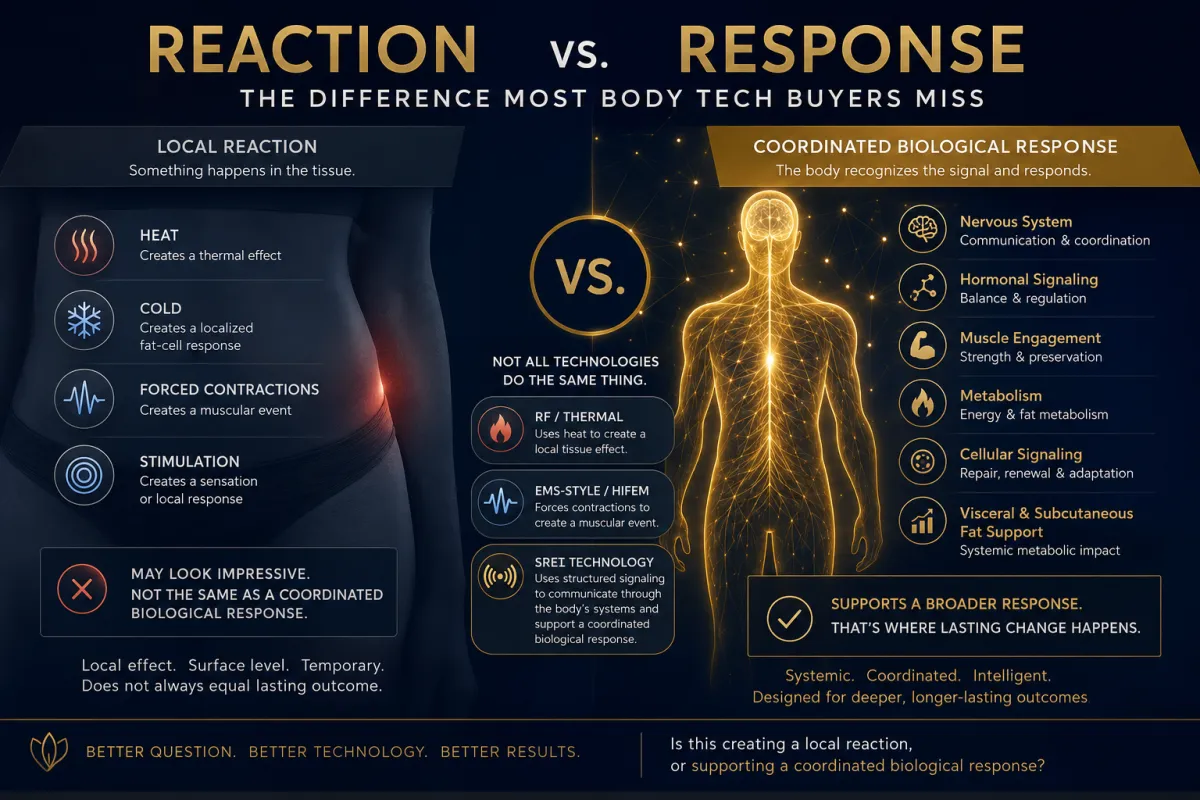
Reaction vs. Response: The Difference Most Body Tech Buyers Miss
Reaction vs. Response: The Difference Most Body Tech Buyers Miss
Why a local effect is not the same as a coordinated biological response
Published by Jill Robertson | Eleve’ Aesthetic Technologies
Quick Answer
Most body-sculpting technologies create a reaction.
Heat creates a reaction.
Cold creates a reaction.
Forced contractions create a reaction.
Sensation creates a reaction.
But a reaction is not the same as a coordinated biological response.
That distinction matters when you are choosing technology for clients who are not just trying to address surface-level fat, but are dealing with metabolic resistance, visceral fat, hormonal shifts, GLP-1-related body changes, inflammation, or the frustrating feeling that their body no longer responds the way it used to.
The better question is not simply:
Does this device do something?
The better question is:
What kind of response does it create inside the body?
Because a local effect and a systemic response are not the same thing.
And clinic owners need to know the difference before they invest.
The Problem: “Something Happened” Is Not a Business Case
A device demo can look impressive.
The client feels heat.
The muscle contracts.
The tissue reacts.
The treatment area looks temporarily different.
The before-and-after photo gets attention.
Something happened.
But for a clinic owner, that is not enough.
The real question is whether that immediate reaction translates into:
Measurable outcomes
Comfortable repeat sessions
Package conversion
Rebooking behavior
Client trust
Longer-term progression
Clear positioning
A service your team can confidently explain
Because “something happened” is not the same as a technology that belongs in your clinic’s long-term treatment ecosystem.
That is where many equipment decisions go sideways.
A device can look exciting in a demo and still fail in daily clinic life if clients do not understand it, staff do not enjoy running it, results are inconsistent, or the experience is not rebook-friendly.
The reaction may be real.
But the business model may still break.
Reaction vs. Response: The Difference
Here is the simplest way to separate the two.
A reaction is usually local, immediate, and often created by force, stress, sensation, heat, cold, or disruption.
A response is more coordinated. It involves the body recognizing the input and activating a broader biological process.
A reaction may happen in one treatment area.
A response may involve communication between the nervous system, metabolism, hormones, muscles, fat metabolism, recovery pathways, and cellular signaling.
That difference matters because many modern clients are not walking into clinics with simple surface-level concerns.
They are saying things like:
“I am doing everything right, but nothing is changing.”
“My body does not respond like it used to.”
“I am losing weight, but I am worried about muscle.”
“My waist changed after menopause.”
“I have stubborn belly fat that does not move.”
“I do not want another extreme treatment.”
Those are not always surface-level problems.
They are often response problems.
Why Sensation Is Not the Same as Outcome
One of the biggest traps in aesthetic and wellness technology is confusing sensation with effectiveness.
If something feels intense, clients may assume it is working.
If something is hot, cold, aggressive, or uncomfortable, it can feel “powerful.”
But intensity is not the same as intelligence.
A strong sensation may create drama, but drama does not automatically create better outcomes, better rebooking, or better body-level change.
Heat can create a thermal effect.
Cold can create a localized fat-cell response.
Forced contractions can create a muscular event.
Electrical or magnetic stimulation can create visible movement.
Those things may be useful for certain goals.
But sensation alone does not tell you whether the body is creating a coordinated response.
The better question is:
Does the technology create a reaction the client can feel, or a response the body can use?
That is a very different standard.
Local Effect vs. Systemic Response
Most traditional body-sculpting technologies are built around local effects.
They are designed to act on a specific area of tissue.
That may include:
Heating tissue
Freezing fat
Forcing contractions
Stimulating a local area
Creating temporary circumference change
Targeting the fat you can pinch
Again, local does not mean useless.
It means local.
A local effect can be appropriate when the client’s concern is also local.
But many of today’s clients are dealing with something broader.
Especially clients over 40, post-menopausal clients, GLP-1 medication users, people with metabolic resistance, and people with visceral fat concerns.
These clients may need support that goes beyond what can be reached through localized tissue disruption.
They may need a technology conversation that includes:
Metabolism
Muscle mass
Visceral fat
Hormonal signaling
Nervous system communication
Inflammation
Energy production
Body composition quality
A local effect may not be enough if the real issue is systemic.
The clinical review on visceral fat makes this distinction clearly: subcutaneous fat is the fat just beneath the skin and can respond to localized approaches like freezing, heating, mechanical disruption, or local stimulation. Visceral fat, by contrast, is deeper and requires a systemic metabolic response, cellular-level signaling changes, and hormonal or neurological involvement.
Why 40+ Clients Often Need a Different Conversation
The body-sculpting client of 2026 is not always the same client this category was originally built for.
A lot of older technology was designed for people who were already relatively fit and simply wanted help with a small pocket of pinchable fat.
That is not the full market anymore.
Many clients today are dealing with:
Hormonal shifts
Slower recovery
Stress overload
Metabolic slowdown
Loss of muscle
Deeper abdominal fat
GLP-1-related body changes
A body that does not respond to the same strategies anymore
For these clients, the issue is often not effort.
It is not that they need to be told to “try harder.”
They are already trying.
The bigger issue is that the body’s response system may not be functioning the way it used to.
That is why a surface-only conversation can feel incomplete.
A 45-, 55-, or 65-year-old client may not be asking for the same thing a 28-year-old low-BMI client is asking for.
She may want inch loss, yes.
But she also wants to feel like her body is responding again.
That requires a better mechanism conversation.
The updated visceral fat review specifically identifies women over 45, GLP-1 medication users, clients with elevated metabolic markers, and “tried everything” clients as key groups whose needs often go beyond the older “inch to pinch” body-sculpting model.
Where RF, EMS-Style Tech, HIFEM, and SRET Differ
This is where category confusion becomes a problem.
Many technologies are grouped together because they all fall under the broad umbrella of “body sculpting” or “frequency-based” devices.
But they are not doing the same thing.
RF and Thermal Technologies
Radiofrequency and similar thermal approaches use energy to heat tissue.
That can create a local tissue effect.
This may be useful for certain aesthetic goals, but it is still primarily a localized approach.
The key question is:
What is the heat being used to do?
Is it creating a controlled thermal effect in tissue?
Is it focused on skin tightening, fat disruption, or surface-level change?
If so, evaluate it as a local-effect technology.
EMS-Style and HIFEM Technologies
EMS-style and HIFEM technologies focus on stimulating or forcing contractions.
They can create visible movement and muscular intensity.
Again, that is a real effect.
But a forced contraction is not automatically the same as a coordinated biological response.
The key question is:
Is the body recognizing the input as a meaningful signal, or is the device simply forcing a local event?
That distinction matters, especially when the client’s deeper concern involves metabolism, visceral fat, hormones, or systemic body composition.
SRET-Based Signaling
SRET, or Signalling Resonance Energy Transfer, is positioned differently.
Rather than focusing primarily on heat, cold, or forced contraction, SRET is built around structured signaling patterns designed to communicate through the body’s own systems.
The purpose is not just to create a local reaction.
The purpose is to support a coordinated response through biological communication.
That is why SRET-based technology should not be lumped in with RF, EMS-style, HIFEM, or thermal devices simply because the word “frequency” appears somewhere in the conversation.
Same broad category.
Different mechanism.
Different questions.
Different outcomes to evaluate.
The SRET documents describe the technology as a framework of complex, programmed micro-signal sequences — not one static frequency — designed to mirror the layered nature of the body’s own communication systems.
Why the Nervous System Matters
The nervous system is the body’s master communication network.
It coordinates the brain, muscles, organs, hormones, stress response, recovery, and metabolic regulation.
If a technology interacts only at the local tissue level, the response may remain local.
But if a technology is designed to communicate through the nervous system, the potential conversation becomes broader.
That is why the nervous system belongs in the body-sculpting discussion.
Not because body sculpting needs more jargon.
Because metabolism, muscle development, fat metabolism, stress response, and repair are all coordinated through communication.
The body is not just tissue.
It is a signaling system.
And for many clients, especially those who feel stuck, the question is not simply how to attack the tissue harder.
The question is how to help the body respond more intelligently.
The SRET science document frames aging and dysfunction as a disruption of biological coherence, where cellular communication, hormonal signaling, and molecular repair lose their coordinated rhythm.
Why This Matters for Clinic Owners
The mechanism you choose affects more than the treatment outcome.
It affects your entire business model.
It affects:
How you explain the service
Who the service is right for
How you package it
Whether clients rebook
Whether your team can run it confidently
Whether the service feels aligned with your brand
Whether the client sees it as a commodity or a category difference
A local-effect technology often competes on price, sensation, or before-and-after drama.
A response-based technology gives you a deeper conversation.
It allows you to speak to the client who wants:
Visible results
Measurable change
Comfort
Metabolic relevance
Muscle building
Visceral fat support
A body that feels like it is responding again
That is a more valuable conversation.
And in a crowded aesthetic market, more valuable conversations matter.
The Question Every Clinic Owner Should Ask
Before investing in any body-sculpting technology, ask this:
Is this creating a local reaction, or supporting a coordinated biological response?
Then go deeper.
Ask:
What system is the technology interacting with?
Is the mechanism local, systemic, or both?
What does the client measure after session one?
Does the result deepen over 7 to 30 days?
Is the experience comfortable enough to rebook?
Does it support muscle, metabolism, and visceral fat — or only surface-level change?
Can your team explain the mechanism in one sentence?
Is there clinical data beyond before-and-after photos?
Does the technology fit your actual appointment flow?
Can it become a core service, not just an expensive add-on?
These questions protect your money, your margin, and your reputation.
What to Watch For on Sales Calls
When evaluating technology, be careful with language that sounds impressive but does not explain the mechanism.
Watch for claims like:
“Frequency-based”
“FDA-cleared”
“Builds muscle and burns fat”
“Targets stubborn fat”
“Clinically proven”
“Up to X% improvement”
“Next-generation”
None of those statements is enough by itself.
They may be true.
They may also be incomplete.
The better move is to ask:
What is the technology actually doing?
How is the outcome measured?
What was the sample size?
What was the protocol?
What kind of client was studied?
Is the effect local or systemic?
What happens after the first session?
What happens after a full series?
A clear mechanism should make the sales conversation easier, not more confusing.
The visceral fat review makes a similar point in its “litmus test” section: clinic owners should ask for evidence of visceral fat reduction, the sample size, the protocol, and the measurement method — not just before-and-after photos, testimonials, or broad marketing claims.
A Better Standard for Body Tech Buyers
The old buying question was:
Does the device work?
The better question is:
What kind of response does it create, and does that response match my clients?
Because the wrong device can still “work” in the wrong clinic.
A technology may create a local effect and still be a poor fit for your ideal client.
A device may produce sensation and still fail to drive rebooking.
A machine may create a dramatic demo and still become a corner decoration six months later.
The best technology is not just impressive.
It is relevant.
Relevant to your clients.
Relevant to your outcomes.
Relevant to your staffing.
Relevant to your pricing.
Relevant to your brand.
Relevant to the biological problem your clients are actually trying to solve.
That is the standard.
The Bottom Line
Most devices create a reaction.
The right technology creates a response.
A reaction can be local, temporary, and surface-level.
A response is more coordinated. It involves communication, recognition, and a broader biological process.
For clinic owners, this difference matters because the client walking through your door today is often looking for more than a surface change.
She may be looking for metabolic support.
Muscle building.
Visceral fat reduction.
A more responsive body.
A solution that feels different from the old-school body-sculpting playbook.
So before buying your next device, do not stop at the demo.
Ask what kind of response the technology is designed to create.
That is where smarter equipment decisions begin.
Frequently Asked Questions
What is the difference between a reaction and a response in body-sculpting technology?
A reaction is usually a local effect caused by heat, cold, stimulation, or force. A response is more coordinated and may involve the body’s communication systems, including the nervous system, metabolism, hormones, and repair pathways.
Why is sensation not the same as effectiveness?
A treatment can feel intense without creating the outcome a clinic or client actually wants. Heat, cold, contraction, or discomfort may create sensation, but sensation alone does not prove meaningful or lasting body-level change.
Are local-effect technologies bad?
No. Local-effect technologies can be useful for certain goals, especially surface-level concerns. The issue is not whether they are bad. The issue is whether they match the client’s real problem and the clinic’s desired outcomes.
Why does the nervous system matter in body sculpting?
The nervous system helps coordinate metabolism, muscle development, stress response, repair, and hormonal signaling. Technologies designed to communicate through the nervous system may support a broader response than technologies that act only on local tissue.
How should clinic owners evaluate new body-sculpting technology?
Clinic owners should ask what the mechanism is, whether the effect is local or systemic, what outcomes are measured, whether results deepen over time, whether the experience is comfortable, and whether the technology fits the clinic’s staffing, schedule, and pricing model.
How is SRET different from RF or EMS-style technology?
RF typically uses energy to create a local thermal effect. EMS-style and HIFEM technologies stimulate or force contractions. SRET is positioned around structured signaling designed to communicate through the body’s own systems, which makes it a different category of mechanism.
Download the 2026 Body Sculpting Decision Kit or book a review call.


