
GLP-1 Weight Loss and Body Composition: What Clinics Need to Know
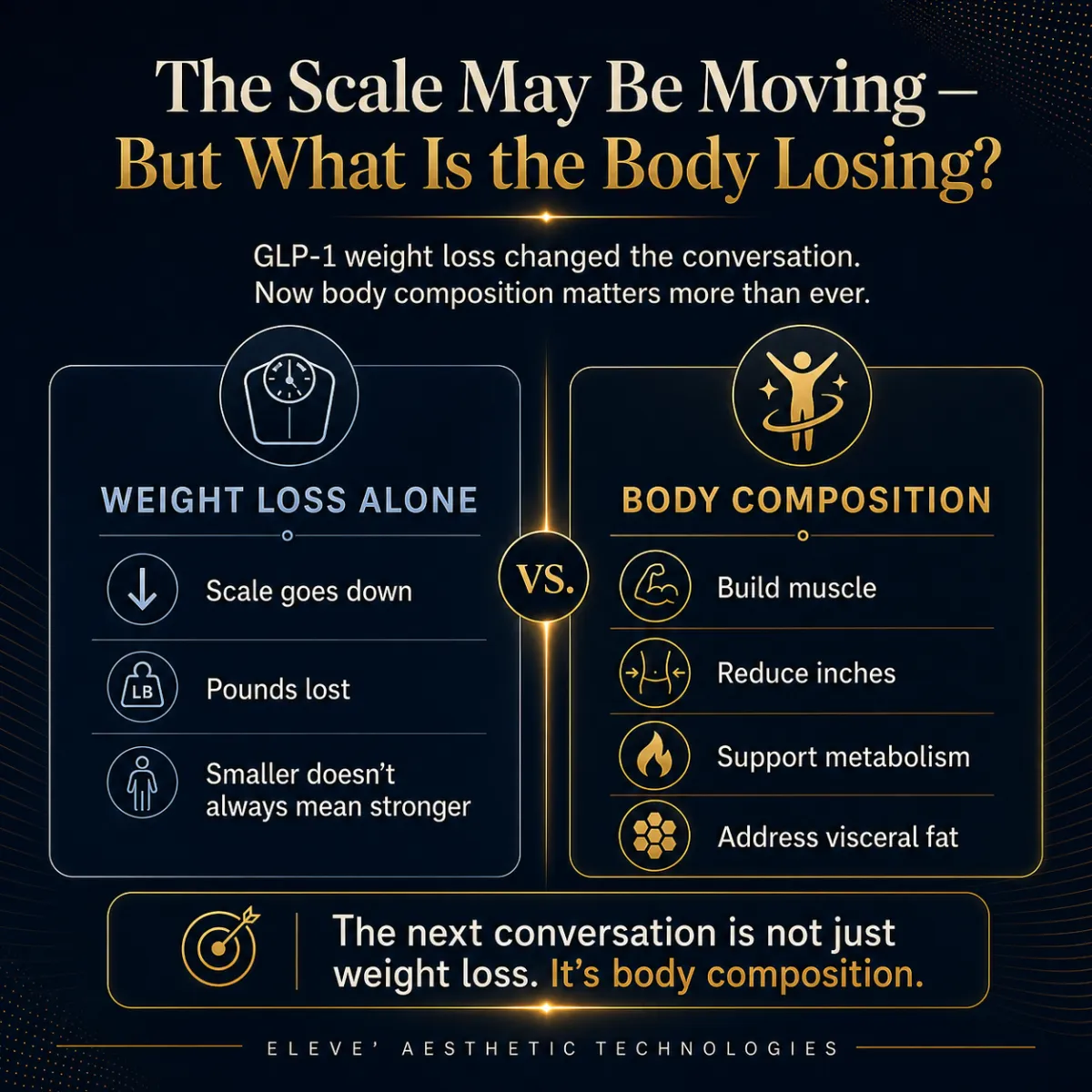
The Scale May Be Moving — But What Is the Body Losing?
Why GLP-1 weight loss is forcing a smarter body-composition conversation
Published by Jill Robertson | Eleve’ Aesthetic Technologies
Quick Answer
GLP-1 medications changed the weight-loss conversation.
But they also created a bigger question for aesthetic, wellness, and body-contouring businesses:
What is the body actually losing?
Because weight loss is not the same as a change in body composition.
A client can lose pounds and still lose muscle.
She can get smaller and still feel softer.
She can drop weight and still struggle with shape, strength, metabolism, or visceral fat.
That is why the next conversation in aesthetics is not just weight loss.
It is body composition.
And the clinics that understand that shift first will be positioned differently.
The Weight-Loss Conversation Has Changed
For years, body-sculpting services were often sold around a familiar promise:
Lose inches.
Reduce fat.
Tone the body.
Look better in clothes.
That conversation still matters.
But it is no longer enough.
GLP-1 medications have changed what many clients think. They may already be losing weight. They may already see the scale moving. They may not need a clinic to help them start weight loss.
They need help understanding what is happening to their bodies as the weight comes off.
That is a very different conversation.
The client is no longer only asking:
“How do I lose weight?”
She is asking:
“How do I protect my muscle, metabolism, shape, and long-term results while my body is changing?”
That is where the opportunity is moving.
Weight Loss Is Not the Same as Body Composition Change
This is where the industry needs to get more precise.
Weight loss simply means the number on the scale went down.
That number can include:
Fat
Water
Muscle
Glycogen
Digestive contents
Inflammation-related fluctuation
The scale does not tell the full story.
Body composition asks a better set of questions:
How much fat was lost?
How much muscle was preserved or built?
What happened to visceral fat?
What happened to metabolic function?
Did the client get stronger or weaker?
Did her shape improve, or did she simply shrink?
Does her body look more supported, or more depleted?
That is the conversation clinic owners need to lead.
Because a smaller body is not automatically a stronger, healthier, or better-composed body.
A client can reach a goal weight and still not like what she sees.
She can lose pounds and still feel like her body looks softer, flatter, or less supported than she expected.
That is not a vanity issue.
That is a body-composition issue.
The Lean-Mass Question Is Not Going Away
The reason this conversation is getting louder is simple:
Lean mass matters.
Research on GLP-1 and GIP/GLP-1 medications shows that weight loss can include both fat mass and lean mass. In a STEP 1 body-composition substudy of semaglutide 2.4 mg, total fat mass and visceral fat mass decreased, but total lean body mass also decreased from baseline, while the proportion of lean mass relative to total body mass increased.
A 2025 SURMOUNT-1 body-composition analysis of tirzepatide reported that approximately 75% of body weight lost was fat mass and approximately 25% was lean mass.
That does not mean GLP-1 medications are bad.
It means the quality of the weight loss matters.
For aesthetic and wellness businesses, this creates an important opening.
The opportunity is not to give medical advice or replace a provider’s plan.
The opportunity is to support the part of the conversation that clients are now worried about:
Muscle.
Shape.
Metabolism.
Visceral fat.
Long-term maintenance.
A body that still feels strong and responsive as the scale changes.
Smaller Does Not Always Mean Stronger
This is the part many clients feel before they know how to explain it.
They may say:
“I lost weight, but I feel softer.”
“My clothes fit better, but my body does not feel strong.”
“I am worried about losing muscle.”
“I do not want to look deflated.”
“I want to keep the results, not just chase the scale.”
That is not the same client conversation body sculpting was built around ten years ago.
The old pitch was often focused on the small area of fat someone could pinch.
But the GLP-1-era client may be thinking about her whole body.
She may want:
Better shape
More structure
Muscle support
Visceral fat reduction
Metabolic support
Long-term maintenance
A body that looks and feels more resilient
So if a clinic is still only talking about “fat reduction,” it may be missing the larger opportunity.
The market is moving from weight loss to body composition.
Why Traditional Body Sculpting May Not Be Enough
Many body-sculpting technologies were originally built around a very specific client.
Someone relatively fit.
Someone near goal weight.
Someone with a small pocket of pinchable fat.
Someone looking for localized contouring.
That client still exists.
But she is not the whole market anymore.
Today’s client may be 45, 55, or 65.
She may be post-menopausal.
She may be losing weight on a GLP-1 medication.
She may be worried about muscle loss.
She may be dealing with metabolic resistance.
She may have visceral fat concerns.
She may not want an aggressive, uncomfortable, or high-intensity treatment experience.
She may not need a device that only acts on one small surface-level area.
That is why mechanism matters.
If a device is designed to heat, freeze, disrupt, or force a local effect, evaluate it as a local-effect technology.
That does not make it useless.
It makes it limited.
And in the GLP-1 era, limited technology may create limited conversations.
The New Client Is Asking a Better Question
The old question was:
“How do I lose fat?”
The new question is:
“How do I improve what my body is made of?”
That is a much better business conversation.
Because body composition includes more than fat reduction.
It includes:
Muscle mass
Fat mass
Visceral fat
Metabolic health
Cellular energy
Recovery
Strength
Shape
Function
This is where clinics can either stay stuck in old body-sculpting language or step into a more valuable category.
The old language says:
“We reduce fat.”
The better language says:
“We help clients improve body composition while their body is changing.”
That is a different position.
And it is much harder to commoditize.
Why Muscle Matters More Than Ever
Muscle is not just about looking toned.
Muscle is metabolically active tissue.
It plays a role in strength, stability, glucose regulation, energy use, posture, aging, and long-term body composition.
So when a client loses weight, the question cannot only be:
“How much did she lose?”
The better question is:
“What did she keep, what did she build, and what changed metabolically?”
That is why resistance exercise and adequate protein are frequently discussed as part of lean-mass support during medically guided weight loss. Mass General notes that consistent exercise and a high-protein diet may help preserve bone and muscle mass during GLP-1 treatment.
For clinics, this matters because body-composition support should complement the client’s provider-guided plan.
Not replace it.
The opportunity is to become part of the client's support system.
Not another place selling a surface-level promise.
The Visceral Fat Conversation Also Matters
The scale does not show visceral fat.
A before-and-after photo may not show it clearly either.
But visceral fat matters.
It is deeper fat stored around organs, and it is closely tied to metabolic health.
Most, if not all, traditional body-sculpting technologies focus on subcutaneous fat — the fat closer to the surface that can be pinched, heated, cooled, or treated locally.
That can be useful for contouring.
But it is not the same as addressing deeper metabolic concerns.
This is where clinic owners need to be careful.
If a technology is evaluated only by surface-level visual change, the buyer may miss the bigger question:
Does this technology have a mechanism to support metabolic and visceral fat changes?
That question matters more now because the post-GLP-1 client is often not just looking for smaller measurements.
She is looking for better body composition.
And that means muscle, metabolism, visceral fat, shape, and long-term response all belong in the conversation.
What This Means for Clinic Owners
The GLP-1 era does not make body-sculpting technology less relevant.
It makes the right body-composition technology more relevant.
But only if the clinic chooses wisely.
Because the opportunity is not to offer the same old pitch to a new group of clients.
The opportunity is to become the place clients go when they are asking:
How do I build muscle while losing weight?
How do I avoid looking soft or depleted?
How do I support my metabolism?
How do I address visceral fat?
How do I maintain my results?
How do I feel like my body is responding again?
That is a much bigger conversation than localized fat reduction.
And it requires better technology, better positioning, and better client education.
What Clinics Should Ask Before Buying New Tech
Before investing in body-sculpting equipment in this market, ask:
Does this technology only create a local effect?
Does it support muscle building, or only create a temporary contraction?
Does it have a mechanism for metabolic change?
Does it address visceral fat, or only subcutaneous fat?
Does it fit the needs of 40+ clients?
Does it support clients currently losing weight?
Can it become part of a body-composition program?
Can the results be measured beyond a photo?
Is the experience comfortable enough for repeat sessions?
Can the service be packaged into a 4-, 8-, 12-, or 20-session progression?
Can your team explain why this matters in one sentence?
These questions matter because the clinic that wins the GLP-1 era will not be the clinic that simply says:
“We help you lose inches.”
It will be the clinic that says:
“We help you improve body composition.”
That is a stronger position.
The Business Opportunity: Body Composition as the Next Category
GLP-1 medications have done something important for the aesthetics industry.
They have made people more aware of the difference between weight loss and body quality.
That creates a new service category.
Not just fat reduction.
Not just muscle toning.
Not just wellness.
Body composition support.
This is where aesthetic clinics, med spas, wellness studios, gyms, and performance centers can create offers that feel more relevant to what clients actually need now.
A strong body-composition offer can include:
Baseline measurements
Muscle-building technology
Metabolic wellness education
Visceral-fat education
Progress tracking
Maintenance packages
Provider collaboration
GLP-1-adjacent support
Long-term client retention
That is not a one-off treatment.
That is a program.
And programs are where recurring revenue, client trust, and better outcomes tend to live.
A Better Way to Position the Conversation
Instead of saying:
“We help you lose weight.”
Say:
“We help you protect and improve body composition while your body is changing.”
Instead of saying:
“We tone muscle.”
Say:
“We help build the muscle and structure clients need for better shape and long-term results.”
Instead of saying:
“We reduce fat.”
Say:
“We look at what kind of fat, what kind of weight, and what kind of body composition change the client actually needs.”
Instead of saying:
“We have body sculpting.”
Say:
“We offer a metabolic body-composition platform for clients who need more than surface-level contouring.”
That language moves the service out of commodity territory.
And that matters.
Because as more clinics add weight-loss programs, injectables, lasers, and body devices, the businesses that can explain the difference clearly will stand out.
The Bottom Line
The scale may be moving.
But the better question is:
What is the body losing — and what is it building?
That is the question clinics need to be asking now.
Because the future of body sculpting is not just weight loss.
It is body composition.
It is muscle.
It is metabolism.
It is visceral fat.
It is shape.
It is function.
It is long-term response.
GLP-1 medications have changed the weight-loss conversation.
Now, body-sculpting technology has to catch up.
The clinics that understand this shift will not just sell treatments.
They will lead the next category.
Frequently Asked Questions
Why is body composition important during GLP-1 weight loss?
Body composition matters because weight loss can include fat, water, and lean mass. A client may lose pounds but still need support for muscle, metabolism, shape, visceral fat, and long-term maintenance.
Does GLP-1 weight loss cause muscle loss?
GLP-1-related weight loss can include reductions in both fat mass and lean mass. The amount varies by medication, study, client profile, diet, exercise, and measurement method. That is why body composition tracking and lean-mass support matter.
Should clients on GLP-1 medications focus on muscle?
Yes, muscle support is an important part of healthy body-composition change. Clients should follow their medical provider’s guidance, and many experts emphasize adequate protein and consistent resistance exercise as part of lean-mass preservation.
How can clinics support GLP-1 clients without giving medical advice?
Clinics can focus on non-medical support such as body-composition tracking, muscle-building services, metabolic wellness education, referral relationships, and aesthetic/wellness programs that complement provider-guided care.
Why is body composition a better conversation than weight loss alone?
Weight loss tells you the scale changed. Body composition tells you more about what changed — fat, muscle, visceral fat, shape, strength, and metabolic health.
What should clinic owners look for in body-composition technology?
Clinic owners should look for technology that supports muscle, metabolism, measurable progress, repeatable sessions, client comfort, and a clear mechanism beyond temporary surface-level change.
CTA
Before you invest in another body-sculpting device, make sure you are asking the right questions.
Download the 2026 Body Sculpting Decision Kit to compare mechanisms, outcomes, clinical evidence, and total business fit before you buy.
Or book a Review Call to talk through whether the Virtual Gym is the right fit for your clinic, wellness center, gym, or med spa.


