
What 45 Minutes Taught Us About Body Transformation
What 45 Minutes Taught Us About Body Transformation
Why real-world outcomes matter more than perfect protocols
Published by Jill Robertson | Elevé Aesthetic Technologies
Quick Answer
Many body transformation technologies are evaluated under ideal conditions.
Perfect protocols.
Perfect timing.
Perfect clients.
Perfect treatment schedules.
But real clients do not live in perfect conditions.
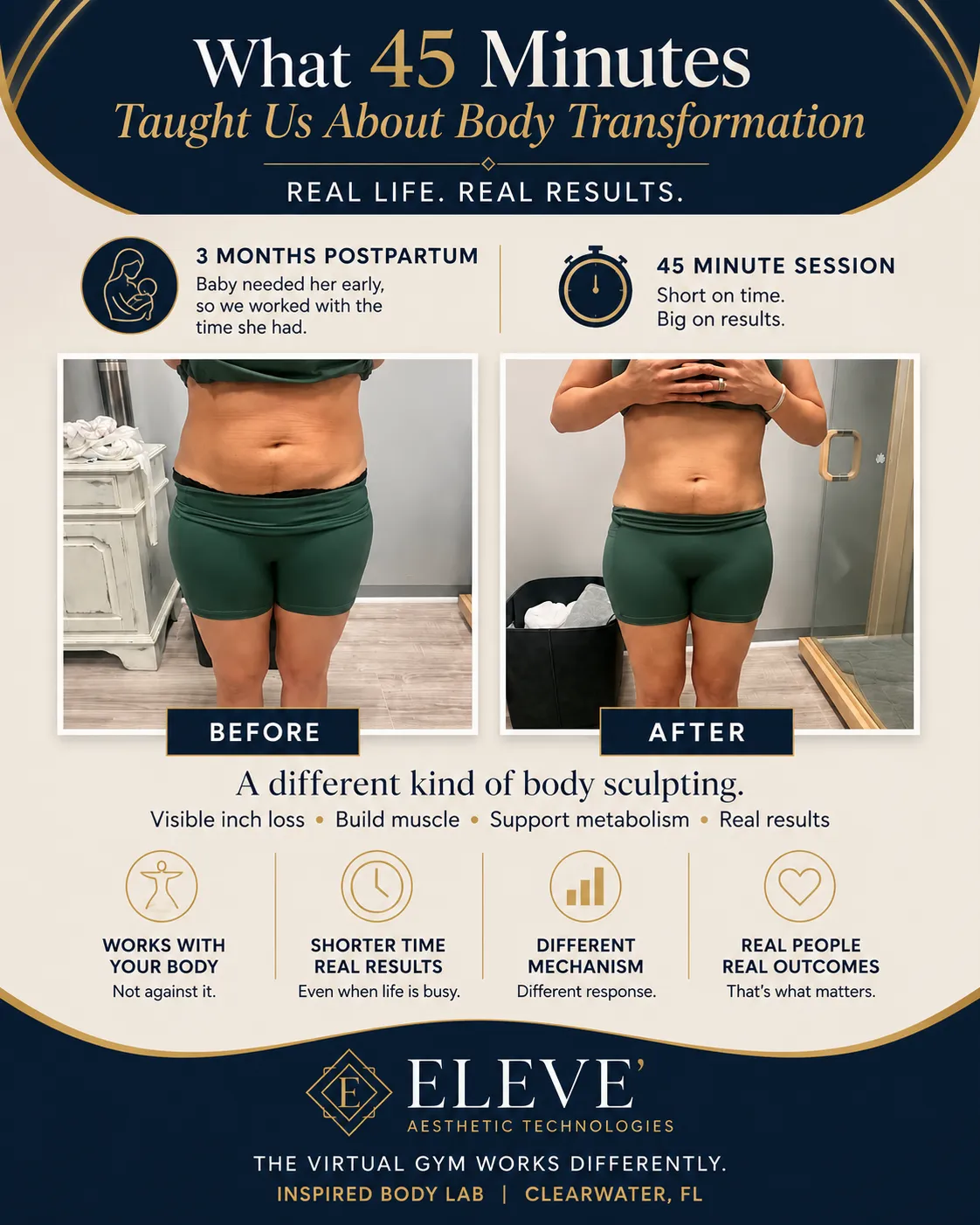
Recently, a client came into the studio just three months postpartum. She did not have time for the standard 60-minute Virtual Gym session because her baby needed her sooner than expected.
So the session was shortened to 45 minutes.
Even with the shorter appointment, visible changes were achieved.
The lesson was not that 45 minutes is a magic number.
The lesson was that body transformation should be measured by biological response — not treatment duration, discomfort, intensity, or how aggressively a device forces the body to react.
For clinic owners, that distinction matters.
Because the most valuable technology is not always the technology that looks the most dramatic in a demo.
It is the technology that works in real life.
The Industry’s Obsession With Perfect Protocols
The body-sculpting and wellness industries love perfect protocols.
A certain number of minutes.
A certain number of sessions.
A certain treatment schedule.
A certain type of client.
A certain starting body composition.
That makes sense from a clinical and operational standpoint.
Protocols create consistency.
They help teams set expectations, measure progress, train staff, and build treatment programs.
But clinic owners also know the truth:
Real clients rarely fit perfectly into the protocol.
They reschedule.
They arrive late.
They have work conflicts.
They have kids.
They have health histories.
They have hormonal changes.
They have stress.
They have travel.
They have caregiving responsibilities.
They have bodies that do not respond like textbook examples.
That is why technology should not only be evaluated by what it can do under perfect circumstances.
It should also be evaluated by how it performs in the real world.
Because the clinic business is not built on perfect clients.
It is built on real people with real lives.
Why Real Clients Don’t Live in Perfect Conditions
One of the biggest mistakes in the body technology space is assuming that client success depends only on the device.
It does not.
Client success also depends on whether the treatment fits into real life.
A working professional may not have unlimited appointment flexibility.
A new mother may not be able to finish a full session.
A client on a GLP-1 medication may need support while her body is changing quickly.
A woman over 45 may need body-composition support without wanting an aggressive or uncomfortable experience.
A metabolically frustrated client may already feel defeated from years of trying.
These are not unusual clients.
These are the clients walking into wellness clinics, med spas, body studios, chiropractic offices, and aesthetic practices every day.
So when a technology only works well in ideal conditions, that can become a business problem.
The real question is not simply:
What can this device do when everything goes perfectly?
The better question is:
Can this technology create a meaningful client experience when life does not follow the plan?
That question matters for outcomes.
It also matters for retention.
What Happened in This 45-Minute Session
This client was three months postpartum.
She came in for a Virtual Gym session, but like many new mothers, her schedule was not entirely her own.
The baby needed her earlier than expected.
Instead of completing the standard 60-minute session, she only had 45 minutes available.
So the session was shortened.
And visible changes were still apparent.
This was not a full program.
It was not a replacement for consistency.
It was not meant to suggest that every client should only do 45 minutes.
But it did demonstrate something important:
The body can begin responding sooner than many people expect when the input is relevant.
That is the lesson.
Not that shorter is always better.
Not that one session replaces a complete protocol.
Not that one before-and-after photo tells the whole story.
The lesson is that a visible response can begin even when the appointment is not perfect.
And for clinic owners, that is worth paying attention to.
Why Response Matters More Than Duration
Treatment duration matters.
Protocols matter.
Consistency matters.
But duration alone does not create results.
The body’s response does.
A 60-minute treatment that creates discomfort but little meaningful change is not automatically better than a shorter session that produces a visible response.
A highly intense treatment is not automatically better than a more comfortable one.
A device that forces a dramatic reaction is not automatically creating a better biological outcome.
This is where many body technology conversations get too shallow.
They focus on:
How long was the session?
How intense did it feel?
How many contractions happened?
How much heat was delivered?
How aggressive was the treatment?
Those questions may describe the treatment.
They do not necessarily describe the result.
The better question is:
How did the body respond?
That is the question clinic owners should be asking before they invest.
Because the client does not come back because the device had an impressive technical specification.
She comes back because she sees and feels that her body is responding.
Force vs. Communication
Most traditional body-sculpting technologies are built around force, stress, or localized disruption.
Heat the tissue.
Freeze the fat.
Force a contraction.
Stimulate the area.
Create a local reaction.
Those mechanisms may have a place.
But they are not the same as supporting a coordinated biological response.
That distinction matters.
A local reaction means something happened in the treatment area.
A coordinated response means the body recognized the input and began participating in the change.
That is a very different category of conversation.
The Virtual Gym is positioned around structured signaling rather than heat, cold, or forced surface-level reaction.
The goal is not simply to attack tissue harder.
The goal is to communicate with the body in a way it can recognize and respond to.
That is why the mechanism conversation matters.
Because if the body is the system creating the result, then the quality of the signal matters more than the intensity of the force.
What This Means for Clinic Owners
For clinic owners, this kind of real-world result matters for several reasons.
First, clients need to trust the service quickly.
A visible first-session response helps people understand that something is different.
It gives the team a stronger conversation.
It helps the client connect the experience to a result.
Second, the treatment experience has to be rebook-friendly.
If a service is painful, intimidating, inconvenient, or difficult to fit into a schedule, clients may not complete the program even if they were interested at first.
Third, today’s clients are not all ideal body-sculpting candidates from the old model.
They may be postpartum.
They may be over 40.
They may be on GLP-1 medications.
They may be metabolically resistant.
They may have visceral fat concerns.
They may be deconditioned.
They may not tolerate aggressive treatments well.
They may be tired of being told to work harder.
These clients need a different kind of conversation.
And clinics need technology that supports that conversation.
Not just a machine that looks impressive on a sales call.
A service that works in daily clinic life.
Why Convenience Matters for Client Retention
Convenience is not a small detail.
It affects whether clients start.
It affects whether they return.
It affects whether they complete the package.
It affects whether they refer someone else.
A body-sculpting service may look exciting on paper, but if the client experience is too uncomfortable, too time-consuming, too hard to schedule, or too difficult to explain, it becomes harder to scale inside a real business.
This is why comfort and rebookability matter.
The easier a service is for a client to understand, tolerate, schedule, and repeat, the easier it is for the clinic to build a program around it.
That does not mean the service should be casual or unstructured.
It means it should fit real life.
A shortened postpartum session is a reminder of that.
Clients are not always choosing between perfect options.
They are choosing between what fits and what does not.
Technology that supports measurable progress inside real-world constraints has a stronger chance of becoming a true revenue channel instead of a rarely used piece of equipment.
The New Standard: Real-World Outcomes
The old buying question was:
Does the device work under ideal conditions?
The better question is:
Does the technology create outcomes that make sense in real clinic life?
Real-world outcomes include more than before-and-after photos.
They include:
Can clients see a difference?
Can clients tolerate the experience?
Can staff explain the mechanism clearly?
Can the treatment be packaged into a program?
Can the service fit into the clinic schedule?
Can clients rebook without dread?
Can the technology support different client types?
Can the results build trust early?
Can the service create a deeper conversation than surface-level contouring?
These questions matter because a clinic does not succeed from one impressive demo.
It succeeds from repeatable client experiences.
The best technology is not just powerful.
It is usable.
It is explainable.
It is rebook-friendly.
It creates outcomes that clients can understand.
And it gives the clinic a reason to lead a more valuable conversation.
Why This Case Study Belongs in the Bigger Body-Composition Conversation
This postpartum session was not just about one client.
It points to a bigger shift in the market.
Clients today are asking for more than traditional body contouring.
They are asking:
Why is my body not responding?
How do I support muscle?
How do I support metabolism?
What happens after weight loss?
What about visceral fat?
How do I feel stronger in my body again?
Is there an option that does not feel extreme?
Those questions are not answered by old-school body-sculpting language alone.
They require a body-composition conversation.
They require a mechanism conversation.
They require a real-world client experience that makes sense for people with busy, imperfect lives.
That is why this 45-minute session matters.
Not because it replaces a full protocol.
Because it shows how quickly a relevant response can begin.
And for clinic owners, that is the kind of experience that gets attention.
What Clinic Owners Should Ask Before Buying
Before investing in another body-sculpting or body-composition device, ask:
Does this technology require ideal conditions to be impressive?
What happens in the first session?
Can clients see or measure change early?
Is the treatment comfortable enough to complete a full package?
Can the service fit into real clinic scheduling?
Can it support clients who are postpartum, 40+, deconditioned, or metabolically frustrated?
Does it rely on heat, freezing, or forced surface-level reaction?
Does the mechanism support a broader body-composition conversation?
Can the team explain the difference in simple language?
Does it create a service clients understand and want to continue?
Can it become a program, not just a one-off treatment?
These questions matter because the right technology should make the clinic’s work easier, not harder.
It should create better conversations.
Better client trust.
Better retention.
And better alignment with the people clinics are actually serving now.
The Bottom Line
The lesson from this 45-minute postpartum session was not that every session should be shortened.
It was not that one appointment replaces a complete program.
And it was not that duration no longer matters.
The lesson was simpler:
Response matters.
Real clients live in real conditions.
Schedules shift.
Babies need attention.
Work runs late.
Life gets complicated.
But when technology is designed to work with the body rather than forcing the body into an old model, meaningful change can begin even when conditions are not perfect.
That is the future of body transformation.
Not harder treatments.
Not more discomfort.
Not more force.
A better signal.
A better response.
A better fit for real life.
Frequently Asked Questions
Was this a full Virtual Gym session?
No. The standard Virtual Gym session is 60 minutes. This client only had 45 minutes available because she needed to leave earlier than planned.
Does this mean 45 minutes is the standard session length?
No. The shortened session was not the standard protocol. The point of this case study is that visible change was still achieved despite real-world time limitations.
Why does this result matter for clinic owners?
It matters because clinic clients do not always live in ideal conditions. A technology that can create visible, understandable results in real-world settings may be easier to package, explain, and rebook.
Is this only relevant for postpartum clients?
No. This example involved a postpartum client, but the larger lesson applies to many client types, including 40+ clients, GLP-1 clients, metabolically frustrated clients, and clients who need body-composition support that fits into busy lives.
Is the Virtual Gym using heat, freezing, or forced contractions?
No. The Virtual Gym is positioned differently from traditional body-sculpting technologies that rely on heating tissue, freezing fat, or forcing surface-level contractions.
Do individual results vary?
Yes. Individual results vary. A single session does not replace a complete program, and postpartum clients should follow their provider’s guidance before beginning body treatments.
Before you invest in another body-sculpting device, make sure you are asking the right question.
Not just:
What does the device do?
But:
How does the body respond?
Download the 2026 Body Sculpting Decision Kit to compare mechanisms, outcomes, clinical evidence, and business fit before you buy.
Or book a Review Call to talk through whether the Virtual Gym is the right fit for your clinic, wellness center, gym, or med spa.


