
When the Body Stops Responding: The Hidden Role of Biological Signaling
When the Body Stops Responding: The Hidden Role of Biological Signaling
Published by Jill Robertson | Inspired Body Lab / Eleve’ Aesthetic Technologies
For clinic owners evaluating body sculpting technology, this loss of biological responsiveness is often the hidden reason why many treatments stop producing meaningful results.
One of the most common things I hear from clients is strangely consistent:
“I’m doing everything right… and nothing is working.”
They’re exercising.
They’re watching what they eat.
They’re taking the supplements.
They’re trying (hard).
And for many people—especially after 40 or 50—this isn’t a discipline problem.
It’s a signaling problem.
The moment it changes (and you can usually name it)
When someone says “my body stopped responding,” I don’t jump straight into macros or workouts.
I ask one question:
“When did it change?”
Most people can name the season immediately:
Stress went up
Sleep went sideways
Hormones shifted
Inflammation increased
Surgery/post-op happened
A big life event hit
Metabolism felt… different
Because the effort didn’t necessarily change.
The body’s responsiveness did.
The body runs on communication
Your body isn’t just tissue. It’s a communication system.
The brain signals muscles.
Hormones signal organs.
Cells signal cells.
The nervous system coordinates the whole show.
This signaling (electrical + biochemical) influences things like:
Metabolism
Fat burning vs fat storage
Energy production
Inflammation patterns
Hunger/satiety and cravings
Repair and recovery
When signaling is clear, the body adapts quickly.
When signaling gets noisy or inefficient, the body often shifts into conservation mode—slower metabolism, more fat storage, more resistance to change.
That’s why strategies that worked in your 30s can feel useless later.
It’s not always because you’re doing it wrong.
It’s often because the signal isn’t landing the same way.
Why so many body sculpting technologies miss the point
Most traditional body sculpting technologies were built to act directly on tissue.
They target structure—what you can physically see.
Examples include things like:
Heating tissue
Cooling tissue
Forcing contractions
Mechanical disruption
Those approaches can create local effects.
But here’s the part people miss:
Metabolism is governed by signals, not just structure.
So if the underlying signaling environment hasn’t changed, the body often adapts right back to where it started.
That’s one reason some results can feel temporary or inconsistent.
The emerging focus: biological signaling
Over the last several years, research in physiology and bioenergetics has focused more on something deeper:
How the body responds to frequency-based communication.
Every organ and tissue operates within measurable electrical rhythms.
The nervous system uses rhythmic patterns to coordinate metabolic processes like:
Fat metabolism
Muscle engagement
Hormone signaling
Cellular repair
When those rhythms get disrupted—stress, aging, poor sleep, toxins, inflammation—communication becomes less efficient.
The body doesn’t “break” overnight.
It just becomes harder to influence.
It stops responding the way it used to.
Noise vs signal (this is the real difference)
Here’s a helpful way to think about it:
If you shout random instructions across a crowded room, people might react for a moment.
But if you speak the same language clearly, people coordinate.
Most devices create a reaction.
The right approach creates a response.
The nervous system is extremely sensitive to patterns.
Signals that mimic the body’s own communication patterns can trigger more coordinated systemic responses.
Signals that don’t match those patterns often create only temporary local effects.
A simple framework if you’re evaluating equipment (steal this)
If you’re considering any body sculpting technology, ask three questions:
Can it produce a measurable Day-0 outcome?
(Tape measure. Not vibes.)
Does it deepen over 7–30 days in a program?
(Not just a one-time reaction.)
Does the mechanism support systemic response—not just local tissue change?
(In other words: is it helping the body respond again?)
This isn’t about finding the most aggressive machine.
It’s about choosing the one that matches how the body actually works—especially for 40+ clients.
How frequency-based signaling approaches the problem differently
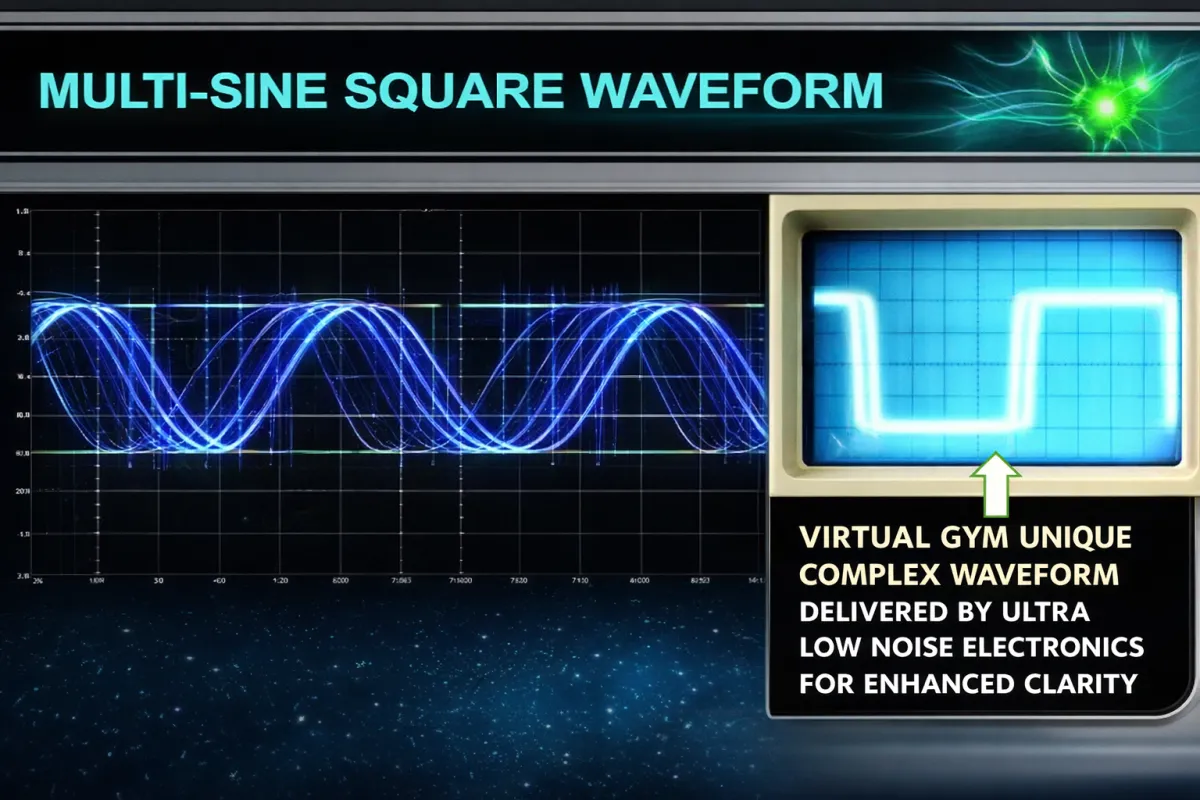
Frequency-based approaches focus less on forcing a structural change and more on improving communication through the nervous system.
One example is the Virtual Gym Max, which delivers structured frequency patterns designed to mimic coordinated physical activity through the nervous system.
This is often described as exercise-emulated signaling.
Instead of trying to “shock” the body into change, the goal is to restore clearer signaling so the body can respond again—more like it did before things got disrupted.
Why clients often notice changes quickly
One of the most interesting patterns practitioners report:
Clients often notice measurable changes after the first session.
On average, clinics report ~3–3.5 inches of combined circumference reduction across waist measurements during the first visit (results vary).
But the more important pattern is what happens after:
Results often continue to deepen over the following weeks as signaling adapts and the body becomes more responsive again.
That suggests something different than a temporary local reaction.
It suggests the body is adjusting its communication patterns.
(As always: results are protocol-dependent and vary by individual.)
Clinical outcomes from a 150-participant study illustrate how restoring coherent signaling patterns can influence metabolism, body composition, and systemic health markers.
A different way to think about body transformation
For many people, the problem isn’t a lack of effort.
It’s that the body stopped responding to the signals being sent.
When the signaling environment improves, something interesting happens:
Energy improves
Measurements change
Progress feels possible again
And for people who felt stuck for years, that shift can be deeply motivating—because it restores hope without requiring more punishment.
The bigger question
As wellness technology evolves, the most important question may not be:
“How aggressively can we force change?”
But rather:
“How clearly can we communicate with the body?”
Because when communication improves, the body often does the rest.
Author
Jill Robertson is the founder of Inspired Body Lab and Eleve’ Aesthetic Technologies. She has worked with frequency-based wellness technology since 2007 and helps both clients and practitioners understand emerging approaches to metabolic support and body transformation.
Frequently Asked Questions
What does “biological signaling” mean?
Biological signaling refers to the constant communication inside the body. The brain, nervous system, hormones, and cells send electrical and chemical signals that influence metabolism, fat storage, energy production, and many other functions. When signals are clear and coordinated, the body adapts more easily to diet, exercise, and lifestyle changes.
Why do some people feel like their body “stopped responding”?
Many people notice that strategies that worked earlier in life stop working later on. Hormonal shifts, stress, sleep disruption, inflammation, and age-related changes can affect signaling efficiency and metabolic responsiveness.
How is frequency-based technology different from traditional body sculpting?
Traditional body sculpting typically targets tissue locally. Frequency-based approaches focus on communication through signaling systems—aiming to deliver structured patterns the nervous system can recognize and respond to. The goal is systemic responsiveness, not just local effect.
Does frequency technology replace exercise?
No. Exercise remains one of the most important tools for metabolic health. Frequency-based sessions are designed to complement healthy habits—not replace them.
Why do some clients see measurable changes quickly?
Some clinics observe circumference changes after the first session, especially around the waist. Results vary widely and depend on hydration, lifestyle, screening, and protocol adherence. Longer-term improvements typically occur across a structured series.
How many sessions are typically recommended?
Protocols vary by goals. Many programs use multiple sessions across several weeks, with maintenance sessions afterward depending on lifestyle and desired results.
Is frequency-based technology safe?
The Virtual Gym Max is registered as an FDA Class I general wellness device (low risk when used as intended). It does not use heat, freezing, or electrical muscle stimulation. Contraindications can include pregnancy, pacemakers, and certain metal implants. Clients with medical conditions should consult a healthcare provider.
Can frequency-based treatments reduce visceral fat?
Visceral fat reduction depends on systemic metabolic change rather than localized intervention. Some research associated with this technology suggests improvements in metabolic and body-composition markers across structured protocols. Individual results vary.
Recommended Reading
Evidence Before Purchasing Body-Sculpting Equipment: a Buyer’s Story
Why Most Body Sculpting Technology Can't Touch Your Hardest Fat — And What Actually Can


