
Why Most Body Sculpting Technology Can't Touch Your Hardest Fat — And What Actually Can
Why Most Body Sculpting Technology Can't Touch Your Hardest Fat — And What Actually Can
Published by Jill Robertson | Eleve' Aesthetic Technologies
Quick Answer
Most body sculpting devices — including cryolipolysis (CoolSculpting), HIFEM (Emsculpt), radiofrequency, and laser lipo — were designed to target subcutaneous fat: the fat you can pinch just under the skin. None of them are clinically demonstrated to reduce visceral fat — the deep, organ-surrounding fat that poses the greatest health risk and is the hardest to lose. As of 2026, AI-guided frequency signaling technology (SRET) is the only non-invasive body sculpting approach with clinical evidence of visceral fat reduction — including a 43.8% decrease in visceral fat across a 150-person clinical study of 20 sessions. For clinic owners evaluating body sculpting technology, understanding the difference between subcutaneous fat and visceral fat is critical.

What Is Visceral Fat? (And Why It's Different)
Visceral fat is the fat stored deep inside the abdominal cavity, surrounding and infiltrating vital organs — the liver, kidneys, heart, pancreas, and intestines. Unlike subcutaneous fat (the layer just beneath the skin that you can pinch), visceral fat cannot be seen or felt from the outside. It is measured by MRI, CT scan, or bioelectrical impedance — not a tape measure.
This distinction matters enormously for anyone evaluating body sculpting technology, because the two types of fat respond to completely different interventions.
Subcutaneous fat responds — at least partially — to thermal stress (freezing, heating), mechanical disruption, and muscle stimulation. Visceral fat does not. It requires a systemic metabolic response, not a localized physical intervention.
Why Visceral Fat Is the Health Problem Nobody Is Solving
Visceral fat isn't just a cosmetic concern. It is the fat most directly linked to serious metabolic disease.
Here's what visceral fat actually does inside the body:
It wraps around and invades vital organs. The term "fatty liver" exists because visceral fat physically infiltrates liver tissue — disrupting its ability to detoxify, regulate blood sugar, and produce the proteins the body needs to function.
It creates walls between cells. When fat accumulates around and between organs, cells lose the ability to communicate with each other efficiently. Signals that regulate hormone production, immune response, and metabolic function become distorted or blocked entirely.
It drives systemic inflammation. Visceral fat is metabolically active — it secretes inflammatory compounds (cytokines) that contribute to insulin resistance, cardiovascular disease, and accelerated aging.
It accelerates hormonal disruption. Because visceral fat interferes with cellular signaling, it directly impairs the body's ability to regulate cortisol, testosterone, estrogen, thyroid hormones, and insulin — creating a cascade of symptoms that diet and exercise alone struggle to reverse.
After 50, exercise can't reach it. This is the point most practitioners miss. The intensity of exercise required to meaningfully reduce visceral fat through physical activity alone is not achievable for most people over 50 — particularly those who are deconditioned, dealing with joint issues, hormonal shifts, or metabolic slowdown. The body simply doesn't respond the same way it did at 35.
What the Research Actually Says About Existing Technology
In a widely cited assessment, the New York Times noted that most body sculpting devices carry a significant asterisk: they are designed for regular gym-goers with minimal extra weight — typically a BMI of 25 or less. The conclusion was direct: none of them work on visceral fat.
This isn't a criticism of the technology. It's an acknowledgment of what it was designed to do.
Cryolipolysis (CoolSculpting): Freezes and destroys subcutaneous fat cells in a localized area. Effective for pinchable fat in low-BMI clients. Has no mechanism for reaching visceral fat. Results can reverse within weeks if the underlying metabolic function isn't addressed.
HIFEM / Magnetic Muscle Stimulation (Emsculpt): Forces supramaximal muscle contractions through magnetic pulses. Builds some muscle tone. Does not address fat metabolism systemically. Has no visceral fat mechanism. Can be uncomfortable and is often unsuitable for higher-BMI clients.
Radiofrequency / Laser Lipo: Uses thermal energy (heat) to disrupt fat cells in the subcutaneous layer. Surface-level results. No systemic metabolic effect. Results are gradual and can be inconsistent.
Red Light Therapy: Mild lymphatic and cellular effect. Limited inch loss at best. No visceral fat mechanism.
The pattern is consistent across all of these modalities: they were built before the research community fully understood the role of visceral fat, cellular communication, and metabolic signaling in body composition. As Dr. Xanya Sofra — Ph.D neurophysiologist, Ph.D clinical psychologist, and M.D., and the developer of the technology behind the Virtual Gym Max — puts it: most body sculpting devices speak noise to the body, not language.
Why Visceral Fat Requires a Different Approach
To understand why frequency-based technology can address visceral fat when other approaches cannot, it helps to understand what visceral fat actually responds to.
Visceral fat is not primarily a structural problem. It is a metabolic and signaling problem.
The body accumulates and retains visceral fat when its internal communication systems are disrupted. When the brain can no longer send clear signals to the cells that regulate fat metabolism, hormone production, and energy use — the body defaults to storage mode. Fat accumulates around organs not because the body is broken, but because it has lost its rhythm.
Dr. Sofra's foundational research, detailed in her book Rhythm of Youth: Unlocking Longevity Through AI-Powered Age Reversal, establishes this principle clearly: biological aging and fat accumulation are fundamentally frequency problems. Every organ and tissue in the body has its own resonant frequency. When those frequencies become disrupted — by stress, poor sleep, environmental toxins, hormonal shifts, and age — cellular communication degrades, metabolism slows, and visceral fat accumulates.
The intervention that addresses visceral fat, therefore, must work at the level of cellular signaling — not at the level of tissue destruction or muscle stimulation.
How AI-Guided Frequency Signaling (SRET) Addresses Visceral Fat
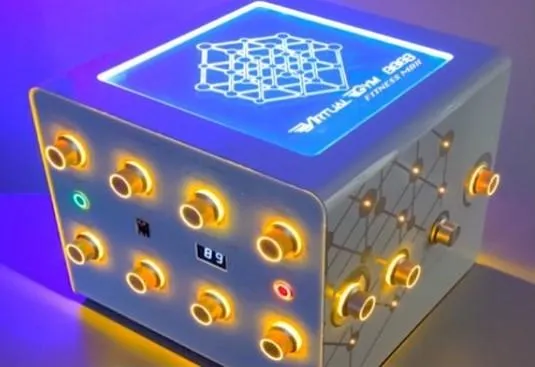
The Virtual Gym Max uses a proprietary technology called ResoSync™, powered by Signal Resonance Energy Transfer (SRET). This is a fundamentally different mechanism from anything else currently available in the non-invasive body sculpting category.
Instead of applying force, heat, cold, or electrical stimulation to tissue, SRET uses AI-guided frequency patterns to communicate directly with the body's natural signaling systems — specifically the central nervous system and the metabolic pathways that govern fat metabolism.
Here is what happens during a session, in plain terms:
The signal is sent. The device emits AI-controlled frequency patterns that mirror the bioelectrical signals the brain uses to regulate fat metabolism, hormone production, muscle engagement, and energy use. Dr. Sofra describes it this way: other devices speak noise to the nervous system. This technology speaks the brain's language.
The brain responds. Because the signal matches the brain's own communication patterns, the brain treats it as a legitimate instruction — and responds by initiating the hormonal and metabolic cascade it would normally produce during intense exercise. This includes secreting growth hormone, activating fat-burning pathways, and triggering coordinated muscle engagement across multiple regions simultaneously.
Fat releases stem cells. This is the finding that distinguishes this technology most dramatically from any competitor. As fat cells respond to the frequency signal and release their contents into the bloodstream, they also release endogenous stem cells. Fat tissue contains approximately one stem cell per 10,000 cells — ten times the concentration found in bone marrow. These are the body's own stem cells, controlled by the brain, capable of repairing liver tissue, kidney tissue, heart tissue, and other vital organs. In a study of participants with non-alcoholic fatty liver disease, approximately 80% achieved normal liver function after approximately 15 sessions.
Visceral fat is addressed systemically. Because the mechanism works through the brain and the body's own metabolic pathways — rather than through localized tissue disruption — it can reach visceral fat in a way that surface-level technologies cannot.
The Clinical Evidence
A clinical study of 150 participants completing 20 sessions documented the following outcomes:
Body Composition
Visceral fat decreased 43.8%
Muscle mass increased 49.5%
Inflammation
C-Reactive Protein (inflammation marker) decreased 37.88%
Hormones
Testosterone increased 42.23% in women / 63.9% in men
Cortisol (stress hormone) decreased 18.42%
IGF-1 (muscle growth and collagen) increased 19.68%
Metabolism
Free T3 (thyroid/metabolism) increased 40.78%
Leptin increased 10.8% (improved appetite regulation)
Ghrelin decreased 10.8% (reduced hunger signaling)
Blood Sugar
Fasting glucose decreased 38.44%
Fasting insulin decreased 41.80%
Cholesterol
HDL (good cholesterol) increased 49.12%
Triglycerides decreased 40.84%
VLDL decreased 41.59%
Liver Health
No fatty liver on sonography in participants who presented with it at baseline
Significant reductions in ALT, AST, ALP, bilirubin, and creatinine
These are not aesthetic outcomes. They are systemic metabolic health outcomes — produced without drugs, needles, surgery, or downtime.
What This Means for Clinic Owners
If you operate a med spa, chiropractic clinic, functional wellness center, or fitness studio, understanding the visceral fat distinction changes how you think about your service menu — and your client conversations.
The clients most likely to walk through your door in 2026 are not the "inch to pinch" clients that 2010-era body sculpting technology was built for. They are:
Women over 45 dealing with hormonal shifts and weight that won't move despite diet and exercise
GLP-1 medication users who are losing weight but need muscle preservation and metabolic support
Clients with elevated glucose, cholesterol, or liver markers who want a non-pharmaceutical intervention
Post-menopausal women dealing with visceral fat accumulation that accelerated after hormonal changes
Anyone who has "tried everything" and stopped seeing results
These clients cannot be served well by technology designed for a different problem. Offering them cryolipolysis or HIFEM is not wrong — it just doesn't address what they actually need.
The clinic that can honestly say "we have a technology that addresses visceral fat with clinical evidence" is offering something categorically different from every other clinic in their market. That is a positioning advantage that compounds over time — in referrals, in retention, and in the ability to charge for outcomes rather than compete on price.
The Visceral Fat Litmus Test
Before investing in any body sculpting technology, ask the manufacturer one direct question:
"Do you have clinical evidence — not case studies, not testimonials, not before/after photos — of visceral fat reduction? What was the sample size, the protocol, and the measurement method?"
If the answer involves MRI or CT imaging with a sample size of meaningful scale and a documented protocol, take it seriously. If the answer pivots to muscle tone, inch loss, or surface-level outcomes — you now know what you're working with.
The 2026 Body Sculpting Decision Kit includes a visceral fat litmus test as part of its evaluation framework. If you haven't downloaded it yet, it's the fastest way to apply this thinking to any device you're currently considering.
Frequently Asked Questions
What is visceral fat and why can't most body sculpting devices reduce it?
Visceral fat is deep abdominal fat that surrounds and infiltrates vital organs. Unlike subcutaneous fat just under the skin, it cannot be reached by thermal stress, freezing, or localized muscle stimulation. Reducing visceral fat requires a systemic metabolic response — specifically, changes in hormonal signaling, cellular communication, and fat metabolism pathways. Most body sculpting devices were designed before this was well understood, and their mechanisms simply don't address these deeper systems.
Which body sculpting technology actually reduces visceral fat?
As of 2026, AI-guided frequency signaling technology using Signal Resonance Energy Transfer (SRET) — as implemented in the Virtual Gym Max — is the only non-invasive body sculpting approach with published clinical evidence of visceral fat reduction. A 150-person study documented a 43.8% decrease in visceral fat over 20 sessions.
Can exercise reduce visceral fat?
Yes, in younger and more conditioned individuals, sustained high-intensity exercise can reduce visceral fat. However, after approximately age 50, the hormonal environment required to generate this response through exercise alone becomes increasingly difficult to achieve — particularly for people who are deconditioned, have joint limitations, or are dealing with hormonal disruption. This is one of the primary reasons frequency-based technology addresses a gap that exercise and conventional body sculpting cannot fill.
How is SRET different from EMS or HIFEM muscle stimulation?
EMS and HIFEM devices stimulate nerves or force muscle contractions through electrical or magnetic pulses. These signals are not recognized by the brain as coherent instructions — they produce a localized physical response but do not trigger the systemic hormonal cascade (including growth hormone secretion and fat metabolism activation) that genuine exercise produces. SRET uses frequency patterns that match the brain's own bioelectrical language, triggering a full coordinated neurological response — including the metabolic effects that address visceral fat.
How many sessions are needed to see visceral fat reduction?
The clinical study documenting significant visceral fat reduction used a protocol of 20 sessions. Most clients notice visible and measurable changes — inch loss, energy improvements, and body composition shifts — within the first 5–10 sessions. The deeper metabolic changes, including visceral fat reduction, liver health improvements, and hormonal rebalancing, compound progressively across the full protocol. Maintenance sessions of 1–2 per month are recommended to sustain results.
Is visceral fat reduction safe with frequency-based technology?
The Virtual Gym Max is registered as an FDA Class I wellness device — general wellness category, low risk. The mechanism involves no thermal stress, no tissue destruction, no electrical stimulation, and no drugs. Contraindications include pregnancy, pacemakers, and metal or mesh implants in the treatment area. Clients with significant medical conditions should be cleared by their healthcare provider. Because the technology works with the body's natural communication systems rather than against them, the process is comfortable, produces no downtime, and has no documented adverse effects in clinical use.
Why do some body sculpting devices claim visceral fat results without evidence?
Marketing claims in the body sculpting industry are frequently made ahead of clinical evidence. "FDA-cleared" means a device has been shown to be similar to another device that was previously cleared — it is a safety and equivalence designation, not an outcomes claim. When evaluating any visceral fat claim, ask for peer-reviewed clinical data with MRI or CT imaging, a documented protocol, and a meaningful sample size. Without these, the claim is marketing, not medicine.
The Bottom Line
Visceral fat is the health problem most people are trying to solve — and the problem most body sculpting technology was never designed to address. Understanding this distinction is the single most important thing a clinic owner can know before investing in new equipment, and the single most powerful thing a client can understand before choosing where to spend their health budget.
The technology exists to address it. The clinical evidence supports it. And the clients who need it are already walking through your door.
If you want to evaluate whether this technology fits your clinic, the 2026 Body Sculpting Decision Kit gives you the framework to decide clearly — without pressure and without guesswork.
👉 [Download the 2026 Body Sculpting Decision Kit]
👉 [Book a Review Call with Jill Robertson]
Jill Robertson is the founder of Eleve' Aesthetic Technologies and Inspired Body Lab in Clearwater, Florida. She has worked with the technology behind the Virtual Gym Max since 2007 and distributes it to med spas, chiropractic clinics, and wellness centers across the United States. The clinical data referenced in this article is available at https://eleveaesthetictechnologies.com/studyresults.
The Virtual Gym Max is an FDA Class I wellness device. It is not intended to diagnose, treat, cure, or prevent any medical condition. Individual results vary. Clinical study results reflect outcomes in a structured 20-session protocol and may not be representative of all users.
Recommended Reading:
When the Body Stops Responding: The Hidden Role of Biological Signaling


